

If you’re considering an atmospheric water generator for your Texas property, the most practical question is straightforward: how does the weather here affect water production?
The short answer is that a Hydropack works well in Texas for most of the year, with the strongest output during the warm, humid months that dominate the Texas calendar. Winter brings the biggest drop-off, particularly around freezing conditions. This guide explains the patterns, what to expect season by season, and how to tell the difference between normal weather-driven variation and an actual system issue.
Texas is generally a favorable environment for atmospheric water generation. Production will naturally rise and fall with temperature and humidity — just like solar panels produce more on sunny days and less on cloudy ones. The key is pairing your Hydropack with the right storage capacity so your household has water regardless of what the weather is doing on any given day.
How Texas Seasons Affect Atmospheric Water Generator Output
Atmospheric water generators extract moisture from the air. That means production is directly tied to two environmental factors: temperature and humidity. When both are high, there’s more water vapor available and the system produces more. When they drop, production decreases.
Texas moves between hot, humid stretches and cooler, drier stretches throughout the year, and that shift changes how much moisture is available for extraction. The pattern holds across most of the state, though coastal areas tend to maintain higher humidity year-round compared to inland regions.
In many parts of Texas, homeowners will see 2–3 months where production is noticeably lower than peak months, and may experience short stretches — often 1–2 weeks — when production is very low or near zero during unusually cold, dry winter conditions.
Day-to-Day Variability: What to Expect
Even within a single day, Texas conditions can shift enough to change production. During the day, the air is often hotter and relative humidity is lower. At night, the air cools while holding similar moisture content, which generally makes conditions more favorable for condensation.
As a result, production may increase overnight, dip during hotter daytime hours, and vary from one day to the next — even within the same week. This kind of fluctuation is normal and should be expected. It’s not a sign of a system issue; it’s a sign that the system is responding accurately to real-time conditions.
Think of it like solar energy: a passing cloud temporarily reduces a solar panel’s output. A dry spell temporarily reduces water production. In both cases, the system is working correctly — it’s the conditions that are changing.
Why Storage Is the Key to Year-Round Water in Texas
This is why every Hydropack installation is paired with an external storage tank.
The strategy is simple: stockpile water during high-production periods so your household has a reliable supply during lower-production stretches.
During the warm, humid months that make up the majority of the Texas year, a Hydropack can produce more water than most households consume daily. That surplus fills the storage tank. When winter arrives and production decreases, the tank provides a buffer that keeps water flowing to your home.
Planning the right storage volume is part of every Aquaria installation. An Aquaria Advisor evaluates your household’s daily water needs, your local climate patterns, and the expected seasonal production curve to recommend a tank size that matches your situation.
Normal Weather Variation vs. a Technical Issue: How to Tell the Difference
One of the most common questions homeowners have is whether a change in production means something is wrong. Most of the time, the answer is no — it’s weather. Here’s how to tell:
Normal and Expected in Texas
- Output rises and falls with weather patterns — more water in humid conditions, less in dry conditions.
- Production varies week to week or month to month as seasons change.
- The system produces water during favorable periods and less during unfavorable ones.
- Production dips during hotter daytime hours and increases overnight.
- A 2–3 month lower-production window in winter, with occasional 1–2 week stretches near zero during cold snaps.
Not Normal — Contact Aquaria Support
- Persistent lack of production during clearly favorable Texas conditions (warm, humid weather).
- A sudden step-change in behavior that isn’t explained by a weather shift.
- The system reports an error condition on the display.
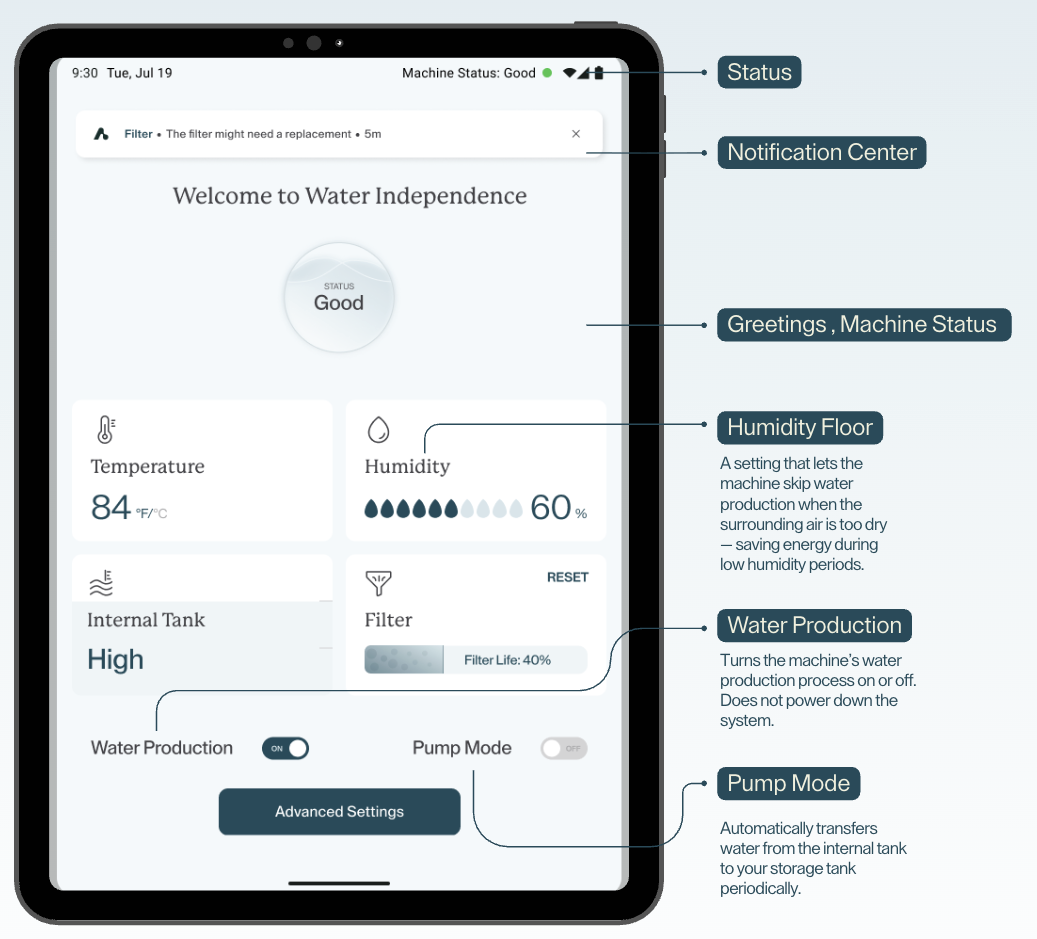
If you’re unsure, a quick check of recent local temperature and humidity conditions is usually enough to determine whether a production change is weather-driven. If conditions are favorable and production is still low, contact the Aquaria support team.
How to Read Your Hydropack’s System Status
Aquaria designed the Hydropack’s system behavior to be straightforward and transparent. At any given time, your unit is in one of three states:
- Producing: Conditions are favorable. The system is actively making water.
- Paused (due to conditions): The right temperature and humidity conditions aren’t present, so production has slowed or stopped. This is a normal, weather-driven pause.
- Paused (due to error): An error has occurred and the system surfaces it explicitly on the display. This is when to contact support.
There isn’t a hidden “half-working” mode where the system quietly fails to produce without any indication. If the Hydropack is paused, it tells you why.
Frequently Asked Questions
Does an atmospheric water generator work in Texas?
Yes. Texas is generally a favorable environment for atmospheric water generation due to its warm, humid climate for most of the year. Production is highest during the hot, humid months from late spring through summer. Winter brings reduced output, particularly during freezing conditions, but pairing the system with a storage tank ensures year-round water access.
How does Texas weather affect Hydropack water production?
Hydropack production is directly tied to temperature and humidity. Warm, humid conditions produce the most water. Hot daytime hours with lower relative humidity produce less. Overnight periods when air cools often produce more. Winter months — especially freezing stretches — produce the least. These variations are normal and follow predictable seasonal patterns.
Does an atmospheric water generator work in winter?
Production decreases in winter as temperatures and humidity drop. In Texas, homeowners typically see 2–3 months of noticeably lower output, with occasional 1–2 week stretches near zero during cold snaps or freezing conditions. The system cannot produce running water when temperatures are at or below freezing. An external storage tank provides the buffer to maintain water access through these periods.
How much water does a Hydropack produce per day in Texas?
Daily production varies based on real-time temperature and humidity conditions. Peak production occurs during warm, humid months — typically late spring through summer in Texas. Output can vary significantly from day to day and even within a single day. Aquaria evaluates each property’s local climate to set realistic production expectations and recommend appropriate storage tank sizing.
Why does my Hydropack produce less water some days?
Day-to-day variation is normal and expected. Production depends on atmospheric conditions, which can change significantly within a 24-hour period in Texas. Common reasons for lower output include lower humidity, higher daytime temperatures reducing relative humidity, or dry weather patterns. If conditions are clearly favorable and production remains low, contact Aquaria support to rule out a system issue.
What size storage tank do I need for a Hydropack in Texas?
Storage tank sizing depends on your household’s daily water usage, your Hydropack model, and local climate patterns. An Aquaria Advisor evaluates these factors during the installation planning process to recommend a tank size that provides reliable water access through lower-production winter months. The goal is to stockpile surplus water during peak production seasons.
Ready to Find Out If a Hydropack Fits Your Texas Property?
Texas weather makes atmospheric water generation practical for most of the year. The next step is understanding whether your specific property, climate zone, and water needs are a strong fit.
Is a Hydropack right for me? — A practical buyer’s guide covering climate fit, property requirements, how real Texas homeowners use their systems, and a quick fit checklist before you talk to an Advisor.
Read the fit guide here or, book a call with our Product Advisor to learn more.
Subscribe to our Newsletter
Get the latest updates, news and insights directly to your inbox
No payments for 6 months. Get your Hydropixel delivered free in the continental US.
Get Your Free Water Plan
Two quick steps. We'll send the right system size, expected output for your climate, and exact pricing — usually within one business day.