
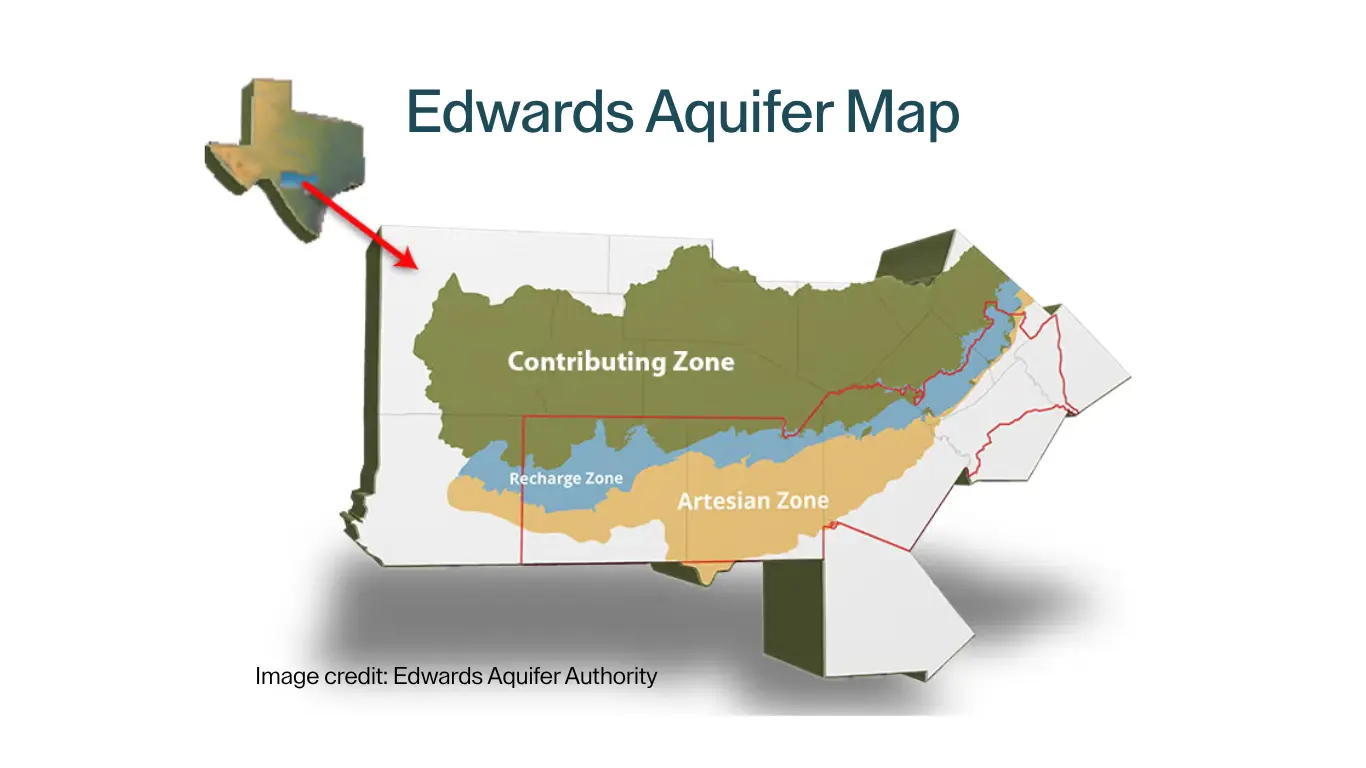
TL;DR: The Edwards Aquifer — the sole drinking water source for roughly 2 million people across San Antonio, Texas, and surrounding communities, is under mounting pressure from drought, population growth, and a new competitor most residents don’t see coming: the rapid expansion of water-hungry data centers across Central and South Texas.
Two million people drink from the same underground rock formation.
That formation is the Edwards Aquifer (Texas, United States), a 3,600-square-mile karst limestone system threading beneath eight counties in Central Texas. It feeds the taps of San Antonio, New Braunfels, San Marcos, Seguin, and dozens of smaller communities. It sustains the Comal Springs and San Marcos Springs, home to several federally endangered species found nowhere else on Earth. And it sits beneath one of the fastest-growing technology corridors in the country.
The data centers are arriving. The aquifer is not getting bigger.
How Bad Is Texas Groundwater Depletion Already?
Texas groundwater stress is in the local news every day, as residents experience dwindling well water production, restrictions, and ballooning water bills.
The United Nations University Institute for Water, Environment and Health (UNU-INWEH) published its Global Water Bankruptcy report in 2026, finding that 70% of the world’s major aquifers now show long-term declining trends, and that in many cases the damage is effectively irreversible on human timescales. Compacted aquifers do not rebound. Subsided land does not rise. The water that took centuries to accumulate does not return within a human lifespan.
Texas sits squarely in that picture. The 2011 drought — the worst single-year drought in the state’s recorded history — pushed the Edwards Aquifer to critical levels, triggering mandatory pumping restrictions across the San Antonio, Texas region for the first time under the Edwards Aquifer Authority (EAA). The aquifer recovered a little bit, but it did not get “fixed”. Climate scientists project that droughts of that magnitude will become more frequent, not less, across the South Texas region.
The UNU-INWEH report frames this precisely: drought is no longer simply bad weather. It is increasingly “anthropogenic”, meaning that human decisions are amplifying it through over-allocation, groundwater depletion, and land degradation rather than rainfall deficits alone. Drought-related damages already cost roughly US$307 billion per year worldwide. In Texas, the compounding pressures are agriculture, surging urban population, and now a third force that residents are now confronting at an alarming rate: data centers.
What Do Data Centers Have to Do with Your Water Supply?
How data centers consume water
Modern data centers are facilities that house the servers powering cloud computing, artificial intelligence, and streaming services. They require enormous volumes of water to cool their equipment. The primary method is evaporative cooling: water is circulated over hot equipment, absorbs heat, and is released as vapor. That water does not return to the aquifer. It is gone.
Texas data centers currently consume approximately 25 billion gallons of water per year, according to state infrastructure projections. By 2030, that figure is projected to reach 399 billion gallons annually, a 16-fold increase driven by AI infrastructure buildout.
To put that in context: San Antonio’s total annual residential water use is roughly 50 billion gallons. The projected data center demand by 2030 would be nearly eight times that. Now, residents and data centers are competing for space water from the same rivers, reservoirs, and aquifers.
Where are these facilities being built?
The answer is directly relevant to anyone on the Edwards Aquifer. The technology corridor running from Austin through San Antonio is anchored by major investments from companies including Microsoft, Google, Amazon, and Apple, and it sits in the heart of the Edwards Aquifer recharge zone. These are the same lands where rainfall percolates through the limestone and replenishes the underground system that 2 million people drink from.
Development on or near the recharge zone doesn’t just consume water. It degrades the land’s ability to absorb and filter precipitation, reducing the rate at which the aquifer naturally restores itself. That is the compounding problem: more demand on one side, reduced recharge capacity on the other.
Corpus Christi Is Already Living This Reality
A city that nearly ran out of water
Corpus Christi (Texas, United States) offers a preview of what aquifer and reservoir depletion looks like when it arrives at the tap.
Corpus Christi’s water supply depends primarily on two surface reservoirs: Choke Canyon Reservoir and Lake Corpus Christi. Both are fed by the Nueces River Basin, which is a watershed that is already over-appropriated, meaning more water rights have been granted than the river reliably produces. During the 2022 regional drought, combined reservoir levels dropped to alarming thresholds, prompting the City of Corpus Christi to issue conservation warnings and fast-track emergency contingency planning.
Unlike San Antonio, Corpus Christi does not sit on a major aquifer. Its backup options are limited. Desalination infrastructure on the Texas Gulf Coast is expensive and years away from meaningful scale. And water from the Nueces River Basin cannot be conjured during drought years when the basin is simply dry.
The data center pipeline and Coastal Bend water
South Texas, including the Corpus Christi metropolitan area, is being actively marketed to data center developers seeking lower land costs and proximity to Gulf Coast energy infrastructure. The Coastal Bend Economic Development Corporation has identified data center recruitment as a regional priority. Each facility that comes online will require a reliable water source in a region that does not have one to spare.
This is not theoretical competition. It is a direct conflict over a finite resource in a drought-prone climate.
Aquifer Depletion vs. What Texas Homeowners Are Actually Doing About It
What most households are doing — and why it’s not enough:
Why atmospheric water generation matters in this context
An atmospheric water generator (AWG) is a device that extracts moisture from the air and converts it into clean drinking water, and so it does not draw from the Edwards Aquifer. It does not tap a reservoir. It is not affected by the data center building next door or the drought cutting regional rainfall by 30%.
The Aquaria Hydropack X, for example, produces thousands of gallons of water a month and connects directly to a home’s existing plumbing, delivering air-sourced water to every tap, shower, and appliance in the house. In Central Texas, where average relative humidity ranges from 50% to 70%, conditions are well within the range required for consistent production year-round.
The Hydropack is a whole-home water supply that operates independently of everything happening underground.
The Bigger Picture: What UNU-INWEH Called “Water Bankruptcy”
The 2026 UNU-INWEH Global Water Bankruptcy report made a stark distinction between water stress, water crisis, and what they are now calling water bankruptcy; a condition in which long-term water use has exceeded renewable inflows and safe depletion limits, and some of the damage is no longer reversible.
The Edwards Aquifer has not yet reached that point. But with population growth, climate-intensified drought, and a 16-fold projected increase in data center water demand by 2030, the signs point toward it.
“The language of crisis, suggesting a temporary emergency followed by a return to normal through mitigation efforts, no longer captures what is happening in many parts of the world.” — UNU-INWEH, Global Water Bankruptcy, 2026
For Texas homeowners, that framing carries a practical implication. Waiting for the system to recover may not be a viable strategy. The more durable answer is independence from the system while there is still time to build it.
What Edwards Aquifer Homeowners Can Do Today
The aquifer pressure is real. The data center buildout is funded and underway. And the drought cycles will keep coming.
None of that has to determine the water security of your home.
The same shift that happened in energy, from centralized grid dependency to distributed solar and battery storage , is now possible for water. Every home that generates its own water from air reduces pressure on the shared systems beneath our feet, while guaranteeing supply regardless of what happens at the regional level.
Explore how the Aquaria Hydropack works for homes in Central and South Texas.
Frequently Asked Questions
How does the Edwards Aquifer work, and why is it important to San Antonio?
The Edwards Aquifer is a karst limestone formation beneath Central Texas, United States, stretching approximately 180 miles across eight counties. Rainwater filters through the limestone recharge zone and collects underground, where it is pumped for residential, agricultural, and industrial use. It is the primary, and in many areas, sole drinking water source for roughly 2 million people, including the majority of residents in San Antonio, Texas.
Why are data centers such a large water consumer?
Data centers use water primarily for evaporative cooling, a process in which water absorbs heat from servers and is released as vapor. Large hyperscale facilities (the type being built for AI infrastructure) can consume millions of gallons per day. Unlike residential use, where much of the water returns to the system through wastewater treatment, evaporated cooling water is effectively removed from the local hydrological cycle.
How much water are Texas data centers projected to use by 2030?
Current projections place Texas data center water consumption at approximately 399 billion gallons per year by 2030, up from roughly 25 billion gallons today. That is nearly eight times the total annual residential water use of San Antonio, Texas.
Is Corpus Christi at risk of running out of water?
Corpus Christi, Texas does not sit on a major aquifer and relies primarily on Choke Canyon Reservoir and Lake Corpus Christ, both fed by the over-appropriated Nueces River Basin. During severe drought years, these reservoirs can drop to critically low levels. With growing industrial water demand and no large-scale alternative supply infrastructure in place, Corpus Christi faces genuine supply risk during extended drought periods.
What is the Edwards Aquifer Authority, and what does it do?
The Edwards Aquifer Authority (EAA) is a regional governmental agency in Texas responsible for managing withdrawals from the Edwards Aquifer. It issues water permits, monitors aquifer levels, and can impose mandatory pumping reductions when the aquifer falls to critical trigger levels. During the 2011 drought, the EAA activated Stage V restrictions for the first time, requiring significant cuts in permitted pumping.
Can an atmospheric water generator work in Central or South Texas?
Yes. Atmospheric water generators (AWGs) require ambient humidity to produce water, and Central and South Texas average between 50% and 70% relative humidity year-round, well within the range needed for consistent output. The Aquaria Hydropack connects to your home’s existing plumbing and produces water independently of the Edwards Aquifer, municipal supply, or any reservoir.
What is “water bankruptcy” and does it apply to Texas?
Water bankruptcy, as defined by the United Nations University Institute for Water, Environment and Health (UNU-INWEH) in their 2026 Global Water Bankruptcy report, is a post-crisis condition in which long-term water use has exceeded renewable inflows and safe depletion limits, with some damage effectively irreversible. The Edwards Aquifer has not yet reached this threshold, but the combination of increasing demand (including data center growth), population increase, and more frequent drought cycles puts the system on a trajectory that warrants serious attention.
How is water from air different from filtered tap water?
A whole-home atmospheric water generator like the Aquaria Hydropack does not filter water from an aquifer, reservoir, or municipal pipeline. It generates water from humidity in the surrounding air. This means it is not subject to the same supply constraints as groundwater or surface water. It also bypasses contamination risks associated with aging infrastructure, PFAS-affected groundwater, and industrial pollution entering source water supplies.
Sources:
UNU-INWEH, “Global Water Bankruptcy: Living Beyond Our Hydrological Means in the Post-Crisis Era,” 2026 • Edwards Aquifer Authority (EAA), Texas • American Society of Civil Engineers (ASCE) 2025 Infrastructure Report Card • Texas Water Development Board (TWDB) • Aquaria internal data.
Subscribe to our Newsletter
Get the latest updates, news and insights directly to your inbox
No payments for 6 months on any Hydropack. Get your Hydropixel delivered free in the continental US.
Get Your Free Water Plan
Two quick steps. We'll send the right system size, expected output for your climate, and exact pricing — usually within one business day.