
If you’re researching water sources that don’t depend on a well, a municipal connection, or delivery trucks, you’ve probably come across atmospheric water generators. The category is real, and it’s more practical than it sounds.
An atmospheric water generator (AWG) extracts water vapor from the surrounding air through condensation, purifies it to drinking-water standards, and delivers it to your home through normal plumbing. No well drilling. No delivery truck. No dependence on municipal infrastructure.
What makes it possible: at any given moment, the atmosphere holds roughly 3.4 quadrillion gallons of water in the form of invisible vapor, about seven times the volume of all the world’s rivers combined.
An AWG taps that supply.
Below is a complete explanation of how the technology works, how Aquaria’s Hydropack implements it, and what it isn’t, because this category gets confused with dehumidifiers, desalination, and other water technologies. It’s none of those things.
Atmospheric Water Generator By Definition
An atmospheric water generator is a system that extracts water vapor from the air through a controlled condensation process, then purifies the resulting water to drinking standards. Think of it as a machine that does what a cold soda can does on a humid day; but deliberately, at scale, and with full filtration built in.
When warm, humid air makes contact with a cold surface, the moisture in that air condenses into liquid droplets. Morning dew on grass is the same phenomenon: overnight cooling causes water vapor to settle as visible moisture. An AWG replicates this process indoors, in a controlled environment, and treats the resulting water before it ever reaches your tap.
What an AWG Is Not
Because AWG is a newer category of product, it gets confused with other water technologies. A clear distinction:
- Not a desalination system — it doesn’t pull water from the ocean or any body of water.
- Not a well or groundwater system — no drilling required, and no dependency on underground aquifers
- Not a rainwater harvesting system — it doesn’t collect precipitation from rooftops.
- Not “just a filter” — it generates water first, then filters it. It doesn’t clean water that already exists in your pipes.
An AWG doesn’t create water from nothing — it collects water that’s already in the air. The moisture has always been there. The technology just makes it usable.
How Aquaria Makes Water from Air: The Six-Step Process
Aquaria’s Hydropack line of atmospheric water generators follows a six-stage process designed for high-volume, reliable household water production. Each stage is engineered specifically for drinking-quality output — not just condensation.
1. Air intake and filtration
Air enters the system through Aquaria’s multi-stage air filtration, which removes common airborne particulates — dust, pollen, and other contaminants — before water production begins. Cleaning the air before extracting water from it is what separates a purpose-built AWG from a consumer dehumidifier.
2. Condensation
Aquaria’s proprietary water-from-air module cools and conditions the incoming air so that moisture condenses into liquid water in a controlled process. The physics are the same as a sweating soda can — the engineering is purpose-built to maximise output at household scale.
3. Collection and internal storage
The condensed water is captured in the system’s internal tank, where it can be processed consistently before moving to purification. This internal buffer keeps the purification stages operating at a steady throughput regardless of ambient humidity fluctuations throughout the day.
4. Multi-stage water purification
The water passes through a multi-stage purification process — including technologies such as ultrafiltration and activated carbon — that removes any remaining particulates, organics, and odor compounds. This is the stage that takes condensed moisture and refines it to drinking water standards.
5. UV disinfection
Aquaria runs automated UV disinfection cycles every 4–8 hours (depending on the model) to keep stored water clean over time. UV disinfection deactivates bacteria and other microorganisms without adding chemicals, ensuring the water stays safe between use cycles.
6. External storage and home delivery
Aquaria recommends pairing the Hydropack with an external storage tank that connects directly to your home’s plumbing. A useful way to think about it: the Hydropack is the solar panel — it generates the resource. The external tank is the battery — it stores what’s been generated so it’s available on demand, regardless of current production rates.
The full system — from air intake to your tap — operates without a water main, without a well, and without a delivery schedule. It runs on electricity, pairs naturally with solar, and produces water continuously as long as there’s humidity in the air.
What a Complete Aquaria Setup Looks Like
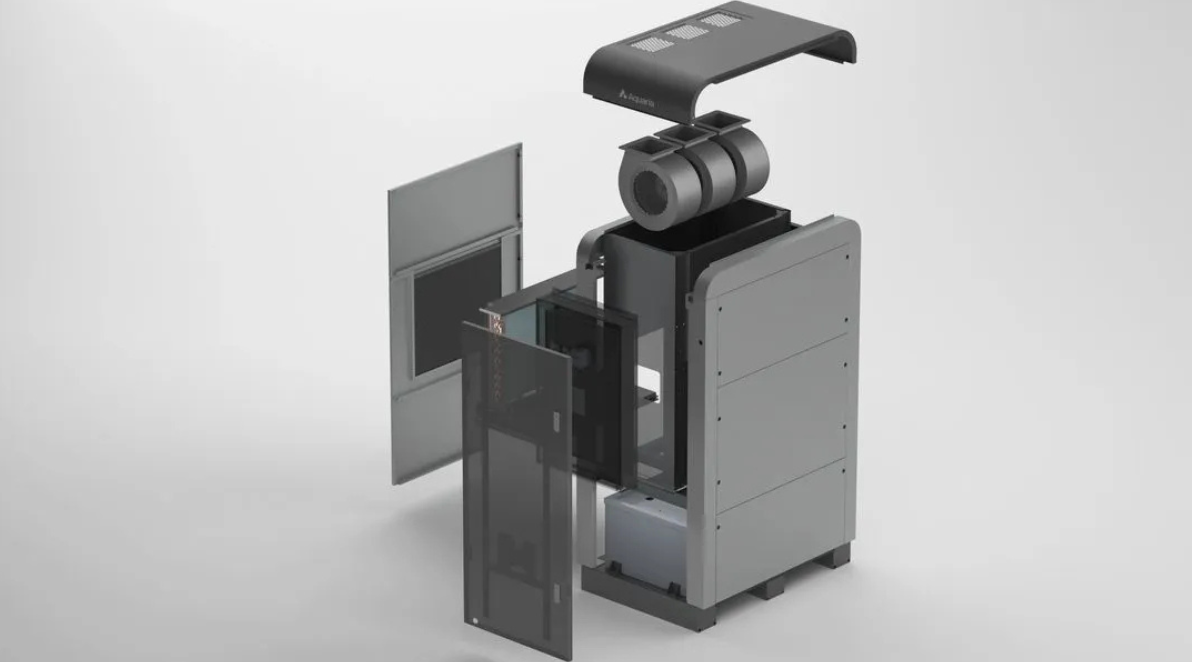
A complete Aquaria installation typically consists of:
- Air intake + multi-stage air filtration (Aquaria’s proprietary design)
- Water production module (Aquaria’s proprietary water-from-air core)
- Internal water tank
- Multi-stage water purification cartridges (ultrafiltration + activated carbon)
- UV disinfection system
- Controls and monitoring (app, tablet, and connectivity)
- External storage tank + home plumbing integration (recommended)

Note: Specific water output and operating behavior vary by local humidity, temperature, and system configuration. Aquaria assesses each installation individually.
How AWG Output Varies by Location
Because an AWG extracts moisture that already exists in the air, its output is directly tied to local humidity and temperature conditions. In hot, humid climates — like Central and South Texas, the Gulf Coast, or the American Southeast — there is significantly more water vapor available, and a Hydropack can produce more water per day.
In cooler or very dry conditions, there is less atmospheric moisture to draw from, and production decreases accordingly. This is why Aquaria evaluates each property individually before installation: output is a function of the machine and the environment, not the machine alone.
For homeowners in the right climate, this is not a limitation — it’s simply how the technology works. A Hydropack paired with an appropriately sized storage tank gives you a buffer: you accumulate water during high-humidity periods and draw from storage when conditions are drier.
Common Misconceptions About Atmospheric Water Generators
“It creates water from nothing.”
Aquaria doesn’t create water — it collects water that’s already in the air. On a humid day, the air carries invisible water vapor distributed throughout the atmosphere. When that warm, humid air contacts a cold surface, the vapor becomes visible liquid droplets. Aquaria replicates this process inside the system: it cools and conditions incoming air so vapor condenses into liquid water, which is then purified and disinfected. The water was already there. The Hydropack just makes it accessible.
“It makes the same amount of water everywhere.”
Output varies by location and weather, because the system is collecting moisture that already exists in the air — and that moisture changes. In hot, humid conditions, there is simply more water vapor available to condense, and production is higher. In cooler or very dry conditions, there is less moisture to pull from, and production decreases. Output is always a function of local humidity and temperature, not just the machine’s specifications.
“It’s just a dehumidifier.”
The physics overlap: both condense moisture from air. The difference is what happens next, and at what scale. A standard dehumidifier is designed to remove humidity from a room and dump the resulting water as waste. An Aquaria Hydropack is engineered to treat that condensed water as a drinking-quality supply — running it through multi-stage purification, UV disinfection, and storage before delivering it through your home’s plumbing.
Beyond water quality, scale matters. A dehumidifier produces incidental water as a side effect of reducing indoor humidity. A Hydropack is built to produce household-level water volumes as its primary purpose. The comparison is a bit like comparing a puddle to a river: they’re both water, but they’re not solving the same problem. See the full comparison: AWG vs. dehumidifier.
“It replaces all my water sources.”
Aquaria is designed to give homeowners more control and optionality over their water supply — not necessarily to eliminate every other source. Depending on how a system is configured, a home can be set up to draw from the Hydropack, a municipal connection, or a well, and switch between them using 3-way T-valves that Aquaria installs as part of the setup.
For homeowners whose electrical panel can handle the power requirements and whose local humidity is a strong fit, a high-volume configuration like the Hydropack X can be set up to serve as the primary — or sole — water source. Adding an extra-large external tank lets you stockpile water during high-humidity periods for use when conditions are drier. Whether that’s the right setup depends on:
- Local humidity and temperature
- Household daily water usage
- Available electrical capacity
- Desired storage tank size and plumbing configuration
The goal isn’t necessarily full independence from every other water source. The goal is reliable, clean water on your terms — with a system that keeps producing regardless of what’s happening with your well, your municipality, or the weather.
Frequently Asked Questions
What does AWG stand for?
AWG stands for atmospheric water generator. It refers to any system that extracts water vapor from the surrounding air and converts it into liquid water for use.
Is water from an atmospheric water generator safe to drink?
Yes, when properly filtered and disinfected. Aquaria’s Hydropack runs condensed water through multi-stage purification — including ultrafiltration and activated carbon — followed by recurring UV disinfection cycles. The output is engineered to drinking-water standards. Water produced from air carries no ground contaminants, dissolved minerals from aquifers, or infrastructure residue from aging pipes.
What humidity level does an atmospheric water generator need to work?
AWGs require sufficient atmospheric moisture to produce meaningful water volumes. Performance improves with higher humidity levels. In very low-humidity environments (desert regions with relative humidity consistently below approximately 30%), an AWG will produce limited water. Aquaria evaluates local conditions before each installation to ensure the system is appropriately sized and configured for the site.
How is an atmospheric water generator different from a dehumidifier?
Both devices condense moisture from air, but their purposes and engineering are fundamentally different. A dehumidifier is designed to reduce indoor humidity and discards the water it collects. An atmospheric water generator is designed to produce drinking-quality water: it filters the incoming air, purifies the condensed water through multiple stages, disinfects it with UV, and delivers it through home plumbing. A Hydropack also operates at household water-production volumes that a standard dehumidifier cannot match.
Does an atmospheric water generator work without electricity?
No. The condensation, purification, UV disinfection, and pumping systems all require electrical power. The Hydropack is designed to pair with solar installations, which allows it to operate off-grid or in a solar-primary configuration. Running on solar means the system can generate water independently of utility infrastructure.
What is the Aquaria Hydropack?
The Hydropack is Aquaria’s residential atmospheric water generator. It captures water from air humidity, runs it through multi-stage filtration and UV disinfection, and connects to a home’s plumbing via an external storage tank. It is designed for homes without reliable municipal water access — particularly in rural areas, properties with failing wells, and drought-affected communities.
How does an atmospheric water generator connect to a home?
Aquaria installs the Hydropack with an external storage tank that feeds into the home’s existing plumbing. The tank acts as a reservoir — continuously replenished by the Hydropack — so water is available on demand through normal household fixtures. Aquaria also installs 3-way T-valves that allow the homeowner to choose between air-generated water and any other connected supply (well, municipal) at any time.
Ready to Find Out If a Hydropack Is Right for Your Home?
Understanding how an AWG works is step one. Step two is knowing whether one makes sense for your specific property — your climate, your water situation, your goals, and your setup. Go straight to our product page to learn more, or book a call with our Product Advisor.
Subscribe to our Newsletter
Get the latest updates, news and insights directly to your inbox
No payments for 6 months on any Hydropack. Get your Hydropixel delivered free in the continental US.
Get Your Free Water Plan
Two quick steps. We'll send the right system size, expected output for your climate, and exact pricing — usually within one business day.