
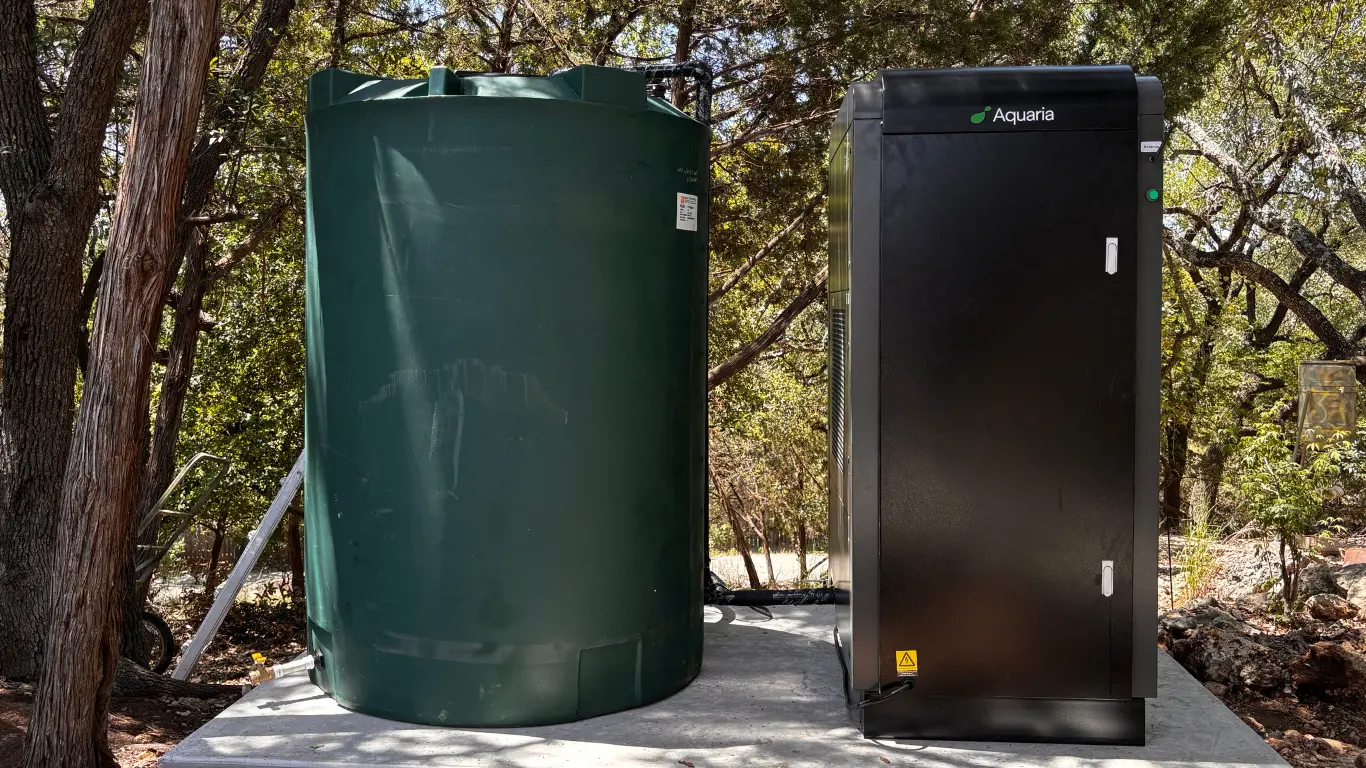
TL;DR: Atmospheric water generator prices in 2026 range from about $770 for small countertop units to $35,000 for whole-home systems. For a Texas household replacing a failing well or building water independence, expect $14,000 to $35,000 for a whole-home Aquaria Hydropack, financeable from $137 a month with $0 down. Installation runs an additional $10,000 to $25,000, often rolled into financing. That math sits well below what most Hill Country homeowners pay to drill a new well.
We have spent the last few years with Texas homeowners walking through this exact decision. The questions used to be about drought and slow well recovery. Now the question is almost always about cost: how much does an atmospheric water generator actually run, and does the math hold up against drilling a new well?
If your well is slowing down, water deliveries are eating $400 a month, or drought restrictions keep tightening, the real question is not whether you can afford an atmospheric water generator. It is whether you can afford to keep doing what you are already doing. This guide breaks down the full price range across the atmospheric water generation (AWG) category, then puts real Aquaria numbers next to the real cost of drilling a new well in Central Texas.
How much does an atmospheric water generator cost in 2026?
It depends on the system. AWG pricing varies widely across manufacturers based on daily water output, filtration standards, build quality, warranty, and whether the unit is sized for a single point of use or a full household — so any single range is misleading.
The Aquaria Hydropack costs $22,499 (financing from $207/month, $0 down). It's sized for medium household, includes independently verified multi-stage filtration, and is built for Texas residential conditions. When comparing options, look past sticker price: cost per gallon delivered, third-party water-quality verification, and long-term reliability are what actually determine value. An Aquaria Water Expert can walk you through sizing and what's included for your home.
A four-person Texas household uses roughly 200 to 400 gallons of water a day for everything from drinking to laundry to showers. The countertop tier that dominates Amazon results, including the small units reviewed by Tyler Falk in his April 2026 piece "Best Atmospheric Water Generators" for TruePrepper, cannot serve that demand. They cap at 18 gallons a day. That is fine for emergency drinking water, but it will not run a household.
The whole-home tier is where AWG stops being a curiosity and starts being a real water source.
What’s the difference between a countertop and a whole-home system?
Output, integration, and water quality. A $770 countertop unit produces 2 to 5 gallons a day and sits on your counter, feeding a single dispenser. A $30,000 whole-home system produces 132 to 264 gallons a day, plumbs into your house like a well or a municipal connection, and supplies every fixture.
For a four-person Texas home, a countertop unit covers drinking and cooking only. A mid-residential 25 gallon-per-day unit covers drinking, cooking, and modest household use. A whole-home Hydropack at 132 to 264 gallons a day covers everything, including a buffer for low-humidity winter months.
Water quality tracks with the tier. Countertop units typically use UV and a single carbon stage. Whole-home systems include multi-stage filtration with reverse osmosis or comparable post-treatment. In independent lab testing by Microbac Laboratories, Aquaria’s Hydropack water tested non-detect on 92 of 100-plus contaminants, including lead, arsenic, nitrates, and total coliform, with total dissolved solids at 4.54 mg/L. That is roughly 99 percent lower than typical Texas tap water and well below the EPA limit of 500 mg/L.
The price gap is not packaging. It is the difference between a drinking-water appliance and a water utility you own.
How does AWG cost compare to drilling a well in Texas?
In most of Central Texas, a whole-home atmospheric water generator costs less than a new well, comes with a guarantee that the well does not, and produces water that does not need a softener, an iron filter, or an arsenic treatment stage.
Drilling a new residential well in Texas typically runs between $9,000 and $25,000. That is the easy case.
The Texas customers who actually call Aquaria are rarely in the easy case. According to Aquaria’s internal market data on Central Texas, homeowners in difficult geology, deep water tables, or remote locations routinely receive well-drilling quotes between $40,000 and $100,000-plus. Hill Country limestone is the most expensive geology in the state to drill through, and there is no refund if the bit comes up dry.
Here is the side-by-side for a typical Hill Country property:
Brent L., one of our customers in Corpus Christi, put it this way:
"I used to be on a well and we had a drought before back in the 80s… and it got so bad that our wells stopped working. We had to have a well digger come out and find more water… I mean we had no other choice."
The well still wins on one variable: if you already own a productive well, the marginal cost of pumping is low. If you are sitting on a working well, do not abandon it. But if you are pricing a new well, or watching an old one fade, the AWG math has moved.
What are Aquaria’s prices and financing options?
We publish full pricing for every model. There are no quote-only tiers and no hidden line items. Here is the current price list and the financing math:
Financing terms across the Hydropack line: $0 down, fixed rates as low as 7.99 percent APR, no payments for the first 6 months. Terms apply and are subject to credit approval.
Installation adds $10,000 to $25,000 depending on the property. Trenching, the external storage tank, electrical work, and delivery are the four big drivers. For a flat, accessible lot near an existing well house and panel, you are at the low end. For a rural property with no graded driveway, a 200-foot run to the panel, and a 2,500-gallon underground storage tank, you are at the high end. Installation can be rolled into financing in most cases.
The math that matters for most Texas homeowners: a Hydropack S at $137 a month is below what many households already spend on bottled water and delivered water combined. A March 2026 collection from Energy Systems Central reports compact home AWGs sitting in the mid four-figure range, with comparable systems from Drinkable Air and Altitude Water priced at $1,800 to $4,650 for units in the 3 to 12 gallon-per-day range. Those numbers are useful context, but they describe units a Texas household would still need to supplement with something else.
If you want to talk through financing for your specific property, book a call with an Aquaria Water Expert. We will walk through your water demand, your humidity profile, and what your monthly number actually looks like. We will also tell you honestly if atmospheric water generation does not make sense for your situation.
What’s the total cost of ownership: electricity, filters, maintenance?
All-in operating cost on a whole-home Hydropack runs about $0.13 per gallon of water produced at standard Texas electricity rates. For a Texas household using the system as a primary drinking and cooking source (roughly 20 gallons a day for a family of four), that is about $80 a month in operating cost. For a property running the Hydropack as a full whole-home water source (200 gallons a day), it is closer to $700 a month, before financing.
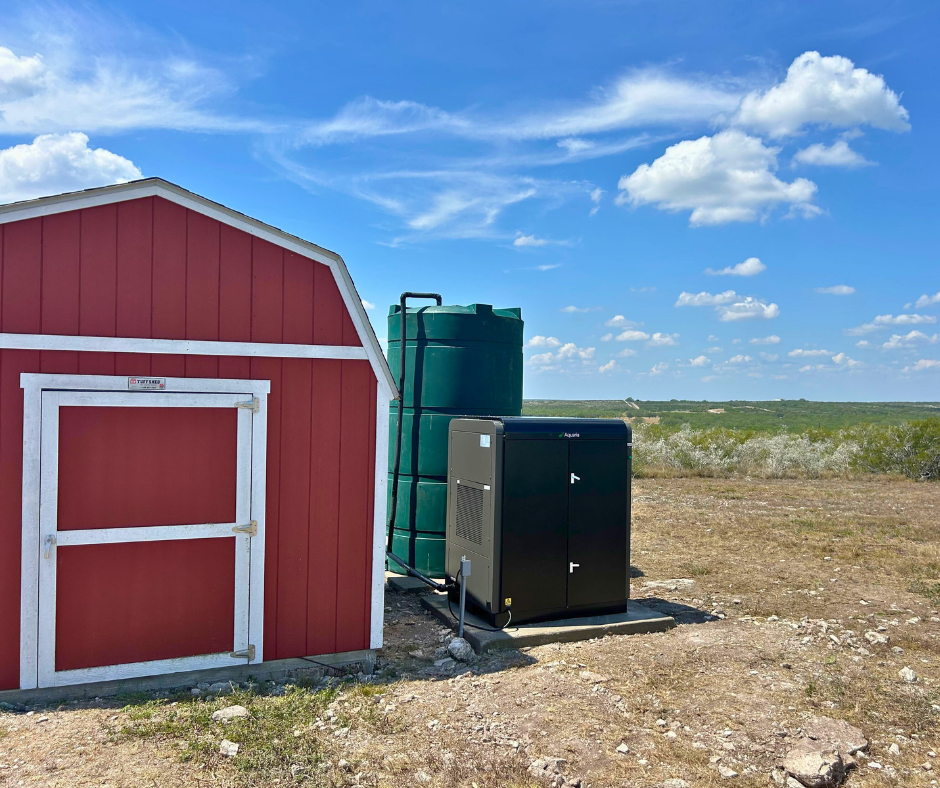
Stop and picture what $0.13 a gallon actually means: a gallon of water Aquaria produces costs you about a third of what a 16-ounce bottle of water costs at the gas station. Same water, generated at the house. No truck. No plastic. No bill from the city.
The line items:
- Electricity: a Hydropack uses about 0.93 kWh per gallon produced. At $0.075 per kWh on CenterPoint in Houston or $0.079 on Oncor in Dallas, that is $0.07 per gallon. San Antonio CPS Energy and Austin Energy run higher at effective blended rates of $0.08 to $0.13 per kWh, pushing it to $0.07 to $0.12 per gallon. Solar offsets cut this significantly. The Aquaria app schedules production during your peak solar generation window to make that work automatically.
- Filters: $100 to $200 per filter set, replaced every 4 to 6 months. Annual filter cost: $200 to $400.
- Maintenance: routine cleaning and inspection are minimal if you follow the schedule in the Aquaria app. No pump to fail, no pressure tank to recharge, no softener salt to refill.
- No water bill: replacing what you currently pay for in bottled water, deliveries, or municipal service removes a recurring $80 to $400 monthly expense for most Texas homes. Over a 10-year window, that alone offsets a meaningful portion of the system cost.
Is an atmospheric water generator worth it for a Texas homeowner?
For a Texas homeowner with a failing well, drought restrictions, or water quality concerns, an atmospheric water generator is one of the cheaper paths to a reliable, independent water supply. For a homeowner with a productive well and clean test results, the math is closer and depends on what you want from the water itself.
The case for going forward:
- Your well is producing less than 5 gallons per minute, or it has gone dry in the past five years
- Your county has issued drought-stage restrictions in the last two years
- Your well water tests have shown elevated arsenic, nitrates, PFAS, or hardness
- You are pricing a new well in difficult geology
- You are already paying for water deliveries or large amounts of bottled water
- You have solar generation that the Aquaria app can use to offset operating cost
The case for waiting:
- Your well produces strong yield and clean water and your aquifer is stable
- You are not in a drought-stress zone and your municipal supply is reliable
- You only need drinking water, in which case a countertop unit or a high-end filter may be enough
The water quality argument is doing more work in Texas than it used to. The U.S. Environmental Protection Agency’s April 2024 "PFAS National Primary Drinking Water Regulation" set enforceable limits at 4 parts per trillion for PFOA and PFOS, and per EPA guidance nearly 50 Texas public water systems currently exceed those limits. In February 2025, Johnson County declared a state of disaster over PFAS contamination [URL pending verification]. Fort Worth filed a $420 million PFAS lawsuit against chemical manufacturers in March 2025 [URL pending verification].
The water we produce does not touch the ground, so it carries no PFAS, microplastics, lead, arsenic, or industrial solvents. In independent lab testing by Pace Analytical using EPA Method 537.1, zero of 14 PFAS compounds were detected in Hydropack water. EMSL Analytical tested for microplastics across six size classes and found zero. Lab results describe tested samples, not universal guarantees, but the testing is comprehensive.
Where to start: how to know which size you need
Sizing comes down to two numbers: how many gallons a day your household uses, and what your local humidity looks like during the worst three months of the year. A rough guide:
- 1 to 2 people, drinking and cooking only: Hydropixel (24 gal/day) at $3,750
- 3 to 4 people, drinking, cooking, modest household use: Hydropack S (66 gal/day) at $13,999
- 4 to 6 people, whole-home: Hydropack (132 gal/day) at $22,499
- Large household, irrigation, livestock, guest properties: Hydropack X (264 gal/day) at $34,999
These are starting points. Real sizing looks at average daily demand, peak summer demand, and how much storage you need to bridge winter. In Hill Country, that is usually two to three months at 28 to 40 percent of rated capacity. A properly sized external storage tank, typically 1,500 to 5,000 gallons, handles the variance.
Frequently asked questions
How much does an atmospheric water generator cost?
Atmospheric water generators cost between $770 for small countertop units and $35,000 for whole-home systems. Commercial systems start at $68,000. Most Texas homeowners replacing a well or building water independence land between $14,000 and $35,000 for the unit, with $10,000 to $25,000 in installation. Aquaria’s Hydropack S starts at $13,999, or $137 a month financed.
How much does it cost to run an AWG per month in Texas?
Operating cost runs about $0.13 per gallon. A Texas household using a Hydropack for drinking and cooking only (roughly 20 gallons a day) spends about $80 a month all-in. A household running it as a whole-home source (200 gallons a day) spends closer to $700 a month, before financing. Solar offsets cut electricity cost significantly.
Is an AWG cheaper than drilling a well?
Yes, in most Central Texas counties. New well drilling in Hill Country and other difficult-geology areas commonly costs $40,000 to $100,000-plus with no guarantee of water. A whole-home Hydropack costs $13,999 to $34,999 upfront, or $137 to $330 a month financed, and produces water the day it is installed. In easier geology with shallow water tables, a well at $9,000 to $25,000 can be cheaper upfront, but ongoing maintenance and water-quality treatment narrow the gap.
Does Aquaria offer financing?
Yes. Aquaria offers $0 down financing on all Hydropack models, with fixed rates as low as 7.99 percent APR, no payments for the first 6 months, and the option to roll installation into the financed amount. Terms apply and are subject to credit approval. Monthly payments start at $137 for the Hydropack S.
How long do atmospheric water generators last?
A well-maintained whole-home AWG should last 15 to 20 years. Aquaria’s Hydropack line uses commercial-grade compressors and heat-exchange components, with filter sets as the only routine consumable. The Aquaria app handles maintenance scheduling and remote diagnostics.
Ready to scope what an atmospheric water generator would cost for your specific property? Book a call with an Aquaria Water Expert. We will give you a real sizing recommendation, a real installation estimate, and a real monthly number. The right next step here isn’t a purchase, it’s a conversation.
Subscribe to our Newsletter
Get the latest updates, news and insights directly to your inbox
No payments for 6 months on any Hydropack. Get your Hydropixel delivered free in the continental US.
Get Your Free Water Plan
Two quick steps. We'll send the right system size, expected output for your climate, and exact pricing — usually within one business day.