
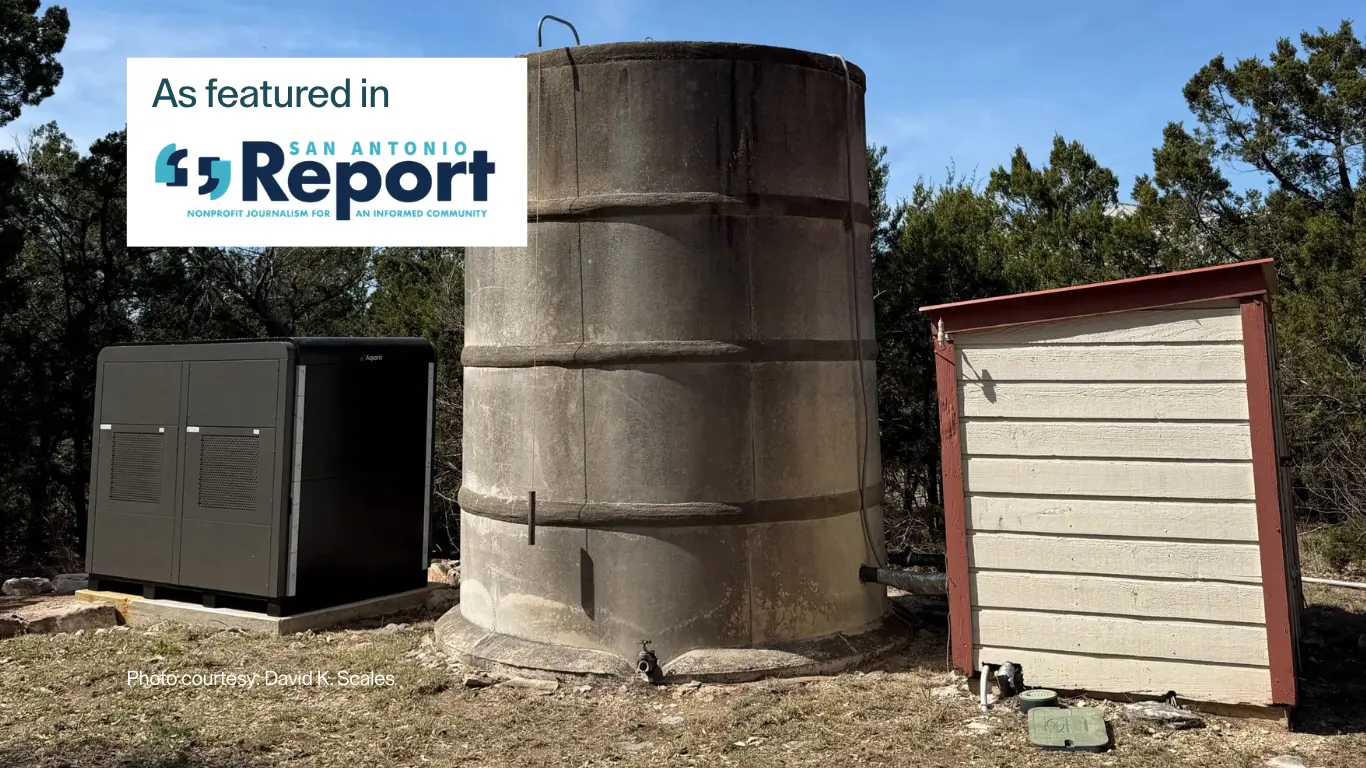
Earlier this month, David K. Scales — a San Antonio ophthalmologist, longtime Bexar County resident, and Aquaria customer — published a commentary in the San Antonio Report about the day his well stopped producing water.
One day the tap worked. The next, his meter read zero.
His piece isn't about a single dry well. It's about a question that more Texans are starting to ask out loud: as data centers arrive in and around San Antonio, are we planning for water the same way we're planning for power?
The scale of what's coming
Scales points to numbers that are hard to ignore. CPS Energy already supplies 21 data centers in the San Antonio area, with another 59 projects in various stages of planning. That growth brings jobs, investment, and long-term economic opportunity, and it also brings new demands on infrastructure.
Most of the public conversation has focused on electricity. That makes sense. Data centers require enormous amounts of power, and anyone who lived through Winter Storm Uri understands why grid stability matters.
But data centers also use water, for cooling and other operations. In parts of Bexar County where residents still rely on groundwater, it's reasonable to ask how industrial demand might affect local supplies.
A practical question, not a political one
Scales is careful to frame this as a planning conversation, not a partisan one. He supported Texas's $20 billion investment in water infrastructure last year. He's not against growth. He's asking a straightforward question: if data center operators are being asked to think about generating more of their own power, shouldn't they also be thinking about how they manage water?
For the families, ranches, and small farms that depend on wells, the stakes are immediate. When a well stops producing, you don't have weeks to figure out what comes next.
Where atmospheric water generator fits in
In his commentary, Scales notes that new technologies are starting to appear at both the home and facility level that can help supplement water supplies. Some data center operators are recycling water inside their facilities. Others, homeowners like Scales among them, are producing water locally from humidity in the air.
This is why we built Aquaria. The Hydropack is an atmospheric water generator designed for exactly the situation Scales describes: homes where the well is uncertain, the pipeline isn't coming, and the family needs reliable water year-round. Every drop passes through multi-stage filtration, with no microplastics, PFAS, or dissolved heavy metals.
It's the same principle Scales raises in his closing question for industrial water users: if the technology exists to produce water closer to where it's needed, it belongs in the plan.
The question worth repeating
San Antonio is doing the right thing by preparing for growth. But as the next wave of data center projects moves forward, Scales leaves readers with the question that should anchor the conversation:
Are we planning for water the same way we're planning for power?
It's a question worth carrying into every permit, every plat, and every ribbon-cutting — for the data centers arriving in Texas, and for the homeowners already here.
This story was first published by the San Antonio Report.
Subscribe to our Newsletter
Get the latest updates, news and insights directly to your inbox
No payments for 6 months. Get your Hydropixel delivered free in the continental US.
Get Your Free Water Plan
Two quick steps. We'll send the right system size, expected output for your climate, and exact pricing — usually within one business day.