
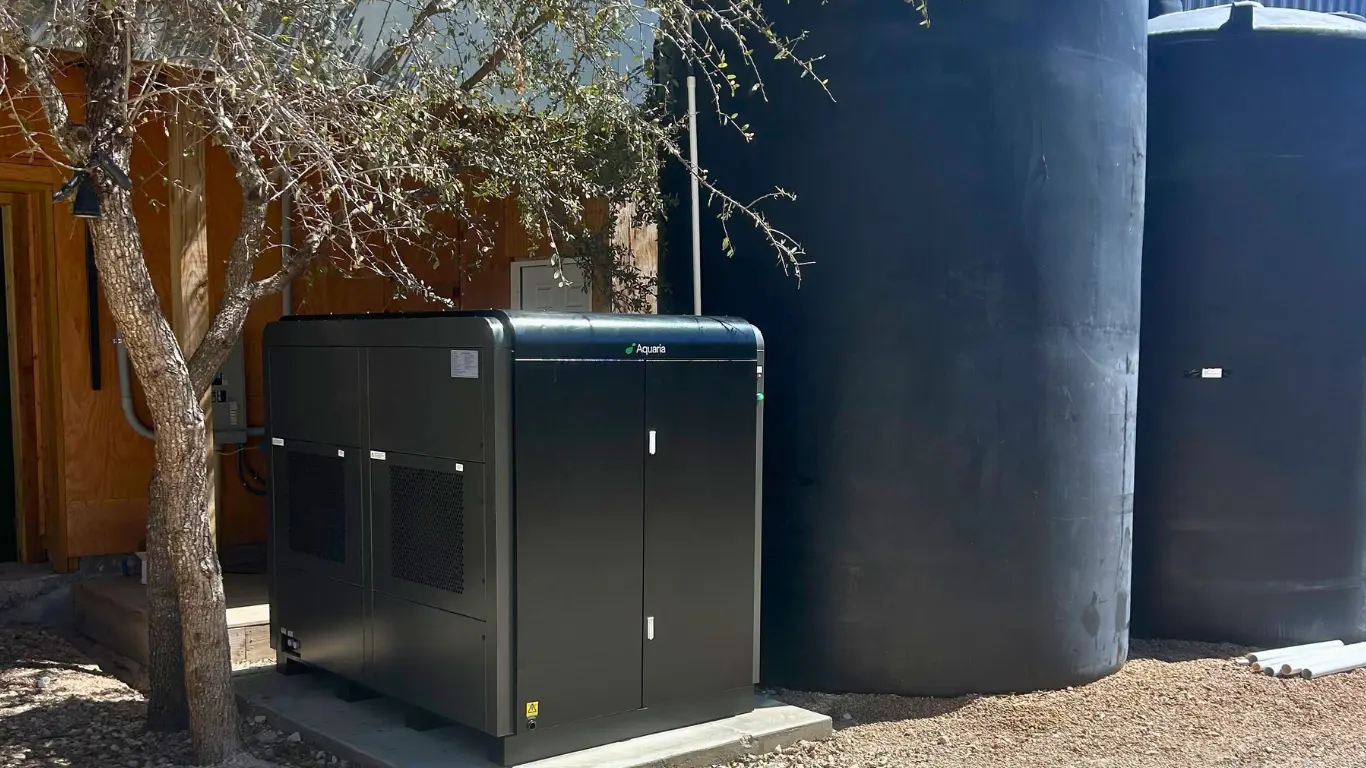
TL;DR: The Aquaria Hydropack X produces up to 264 gallons of clean drinking water per day from thin air, enough to supply a full household. It is the first atmospheric water generator built for whole-home use, integrated with home plumbing rather than sitting on a countertop. Pricing starts at $13,999 for the Hydropack S (66 gal/day) and runs to $34,999 for the Hydropack X, with financing from $137/month.
If you have been looking at atmospheric water generators and finding only countertop units that produce 2 to 10 gallons a day, that’s because, until now, that’s the whole category. At Aquaria, based in Texas, we’ve spent the last few years talking with homeowners who want a real water source from the air, not a kitchen accessory, and the same question keeps coming up: is there one big enough to actually run a house? The Hydropack is our answer.
Hydropack at a Glance
¹ At 30°C / 80% relative humidity. Real-world output depends on local humidity. Expect roughly 50% of rated max at 60% RH, near-zero below 30% RH.
² $0 down, fixed rates as low as 7.99%, no payments for 6 months (terms apply). Installation ($10,000 to $25,000 depending on storage tank, trenching, and electrical work) can be rolled into financing.
All three models connect directly to your home’s plumbing through an external storage tank. Once installed, the Hydropack runs as a fixed appliance, the way a water heater or HVAC system does.
If you already know your situation calls for a whole-home AWG, the fastest way forward is a quote. Get pricing and talk to an Aquaria Water Expert, and we’ll tell you which model fits your property, or whether AWG is the wrong answer for your case. We’ll do the latter when it’s true.
What does “whole-home atmospheric water generator” actually mean?
A whole-home atmospheric water generator (AWG) is a system that produces water from the air to cover all of a household’s needs (drinking, cooking, bathing, laundry, irrigation), rather than just supplementing a kitchen tap. The output threshold for “whole-home” is around 100 gallons per day. Below that, you’re supplementing. Above it, you’re supplying.
The U.S. Environmental Protection Agency’s WaterSense program estimates the average American family uses about 300 gallons of water per day at home, roughly 70% of it indoors. Most of that volume is bathing, toilets, and laundry, which are high-volume uses that a 5- or 10-gallon-per-day countertop AWG cannot touch. To actually replace or back up a household water source, you need an AWG producing in the 100 to 300 gallon range.
This is where the existing AWG market mostly doesn’t compete.
The category has been built around two tiers: small countertop dispensers (2 to 15 gal/day, drinking water only) and commercial-scale “farms” (thousands of gallons per day, for villages or industrial sites). The household tier, large enough to matter and small enough to fit in a utility room, has been mostly empty.
Why hasn’t anyone built a whole-home air water generator until now?
Scaling AWG technology to whole-home output is harder than scaling up a dehumidifier. Three engineering problems sit in the way: throughput, purity, and integration.
Throughput is the most obvious one. To pull 100+ gallons of water out of ambient air every day, you need to move a tremendous amount of air across cold surfaces while keeping the energy cost reasonable. Stop and picture that. A 264-gallon-per-day machine is condensing about a ton of water from air every single day, quietly, in a utility closet, while you sleep. That requires purpose-built refrigeration and air handling, not a repurposed dehumidifier.
Purity is the second. Condensation alone is not drinking water. The water that comes off the cold coil has touched the air’s particulates, and storing it for hours without disinfection invites biological growth. A whole-home AWG has to filter, purify, and disinfect at production rates that match its output, not as an afterthought.
Integration is the third, and the one most AWG companies have skipped. A countertop AWG is a dispenser. It lives on your counter and people fill cups from it. A whole-home AWG has to connect to plumbing, work with a storage tank, and behave like the appliance it is. Most companies optimized for portability or for commercial-scale skid systems and jumped straight over the household tier.
How does the Hydropack work, end to end?
The Hydropack runs a six-stage process designed specifically for high-volume household water production:
- Air intake and pre-filtration. Air enters through multi-stage filtration that removes dust, pollen, and particulates before condensation begins. Cleaning the air first is what separates a purpose-built AWG from a dehumidifier.
- Condensation. Aquaria’s water-from-air module cools incoming air below its dew point in a controlled environment, condensing moisture into liquid water at household scale.
- Internal collection and buffering. Condensed water is held in an internal tank (31.7 gallons in the Hydropack S, 74 gallons in the Hydropack and Hydropack X) so downstream purification runs at a steady throughput regardless of how humidity fluctuates during the day.
- Multi-stage purification. Water passes through ultrafiltration and activated carbon stages, removing any remaining particulates, organics, and odor compounds. This is the stage that turns condensed moisture into drinking water.
- UV disinfection. The system runs automated UV cycles every 4 to 8 hours (depending on the model) to keep stored water clean over time. UV deactivates bacteria and other microorganisms without adding chemicals.
- External storage and home delivery. The Hydropack pairs with an external storage tank that connects directly to your home’s plumbing. That’s what makes it whole-home rather than a large countertop unit.
We sized this process around the question we kept hearing from homeowners: can it actually run a house? Every stage was engineered for the answer to be yes.
What does Hydropack water actually contain (and what doesn't it contain)?
In independent lab testing, Hydropack water tested non-detect for lead, arsenic, nitrates, PFAS, microplastics, E. coli, and total coliform — across more than 50 contaminants screened. Total dissolved solids measured roughly 99% lower than typical municipal tap water.
Testing was conducted across three independent ISO-accredited labs: SimpleLab (general water quality), Pace Analytical (PFAS, via EPA Method 537.1), and EMSL Analytical (microplastics, all size classes tested). See the full water quality report →
How does the Hydropack compare to other existing AWGs?
Most products marketed as “residential atmospheric water generators” today fall into one of two buckets:
- Countertop AWGs (2 to 15 gallons per day) are drinking-water-only units that sit on a kitchen counter. Useful for a household’s drinking and cooking water, but not a household supply.
- Larger residential AWGs (15 to 120 gallons per day) are appliance-form-factor units that come closer to whole-home volume but still top out below typical household demand.
The Hydropack X sits in a third tier: 264 gallons per day at rated conditions, more than double the largest existing residential AWG and roughly enough to supply the indoor water needs of a medium-to-large household. The Hydropack (132 gal/day) is the right fit for a smaller household or as a hybrid setup paired with municipal water. The Hydropack S (66 gal/day) covers drinking, cooking, and partial domestic use. You can see the full Hydropack model lineup and specs on the product page.
Countertop AWGs serve a real purpose: clean drinking water at a single point of use, without bottles. The Hydropack family is built across the rest of the tier hierarchy: from drinking-water scale (Hydropack S) up through whole-home demand (Hydropack X), so the system can be sized to the home rather than the other way around.
Where does the Hydropack work best, and where does it struggle?
The Hydropack performs best at humidity above 50% and temperatures between 70°F and 85°F, the same broad band where the U.S. Gulf Coast, Florida, Hawaii, much of the East Coast, and coastal California spend most of the year. Production stays strong down to about 35% RH. Below 30% RH it drops sharply, which is why every Hydropack installation in dry climates includes a sized external storage tank to ride through low-humidity periods.
For comparison, the air itself is not the constraint. The atmosphere holds roughly 37.5 million billion gallons of water, regenerated every 8 to 9 days through the natural water cycle. The constraint is condensation efficiency at the local humidity and temperature on a given day. We publish monthly production estimates by city for the markets we serve so the math is transparent before anyone signs a financing agreement.
Who is the Hydropack for?
Preparedness-minded homeowners, the ones who already own a backup generator and are looking for the water equivalent. The Hydropack is the appliance answer to “what happens to my water when the system fails?” David and Gladys Scales, San Antonio, put it cleanly: “We have the potential to be energy and water self-sufficient.” That’s the category.
Rural homeowners with failing or contaminated wells. When drilling a new well runs $40,000 to $100,000 with no guarantee of clean water, and especially when local geology means high arsenic, nitrates, or saltwater intrusion, the Hydropack X can replace a well entirely. Brian S., Hill Country TX, summed up the trade: “I didn’t want to put out $70,000 to drill a well when I could get into something like Aquaria.” For context on the cost comparison, see our 2026 atmospheric water generator price guide.
Solar and battery homeowners completing their independence stack. If you’ve already done the work to generate your own power, water from air is the obvious next layer. Hydropack plus an external storage tank is to your water what a solar array plus a Powerwall is to your energy. Same idea, same logic.
Most homeowners aren't trying to leave city water. They want a second source, for boil notices, tightening restrictions, rising rates, and homes that never had a reliable system to start with.
What does installation involve?
Installation typically takes a few days and does not require permitting in most jurisdictions. The Hydropack is delivered, set on a pad or in a utility space, wired to a dedicated 220V circuit (20A, 30A, or 50A depending on the model), and plumbed to an external storage tank that ties into the home’s water lines. Aquaria’s installation network in Texas, Florida, and California handles the full process: survey, install, commissioning. Installation costs ($10,000 to $25,000 depending on storage tank size and electrical work) can be rolled into financing. For the full process, see our walkthrough of what to expect from a Hydropack installation.
The right next step
If you’re seriously evaluating whole-home AWG, the right next step isn’t a purchase. It’s a conversation. Book a call with our Water Expert. We’ll walk through your property, your climate, your household demand, and your existing water source, and we’ll tell you honestly whether the Hydropack fits. We’ll also tell you if it doesn’t. The wrong-size system or the wrong climate will frustrate everyone, and a 15-minute call usually catches that before anything is ordered.
Frequently asked questions
Is water from an atmospheric water generator safe to drink?
Yes, when it’s produced and disinfected properly. In independent lab testing, Hydropack water has tested non-detect for lead, arsenic, nitrates, E. coli, PFAS, and microplastics. The Hydropack purifies through ultrafiltration and activated carbon, then runs automated UV disinfection cycles every 4 to 8 hours to keep stored water clean.
How many gallons per day does a whole-home AWG need to produce?
About 100 to 300 gallons per day, depending on household size. The U.S. EPA’s WaterSense program estimates the average American family uses around 300 gallons per day at home, so a Hydropack (132 gal/day) covers indoor drinking and cooking comfortably for most households, and a Hydropack X (264 gal/day) can cover full indoor demand for a medium-to-large home.
Will the Hydropack work in my climate?
It depends on local humidity. The Hydropack runs efficiently above 35% relative humidity and is most productive above 50%. Coastal and Gulf states, Florida, Hawaii, much of the East Coast, and coastal California are well-suited. Drier inland climates (high desert, parts of the Mountain West) see reduced output and benefit from a larger storage tank.
How does the Hydropack connect to my home’s plumbing?
Through an external storage tank. The Hydropack produces water, sends it to the tank, and the tank feeds your home’s water lines through a pressure pump. From your faucet’s point of view, it works the same as a well or city water. Open the tap, get water.
Do I need a permit to install a Hydropack?
In most jurisdictions, no. The Hydropack runs on standard residential electrical and ties into existing plumbing without drilling, trenching to a water table, or requiring well-driller credentials. Local rules vary, and Aquaria’s installation partners check permitting on every job.
What’s the difference between the Hydropack S, Hydropack, and Hydropack X?
Output. The Hydropack S produces up to 66 gal/day and fits small households or supplements drinking water. The Hydropack produces up to 132 gal/day, a comfortable fit for a typical household’s indoor needs. The Hydropack X produces up to 264 gal/day, sized for medium-to-large homes, properties with irrigation needs, or households that want a full whole-home supply with margin.
Can I run a Hydropack on solar power?
Yes. The Hydropack draws 3.0 kW (S), 5.12 kW (standard), or 10.24 kW (X) at rated load, well within the range of typical residential solar-plus-battery setups. The Aquaria app can schedule production to align with solar generation windows or surplus battery capacity, which is part of why solar homeowners often pair Hydropack with their existing stack.
Subscribe to our Newsletter
Get the latest updates, news and insights directly to your inbox
No payments for 6 months on any Hydropack. Get your Hydropixel delivered free in the continental US.
Get Your Free Water Plan
Two quick steps. We'll send the right system size, expected output for your climate, and exact pricing — usually within one business day.