
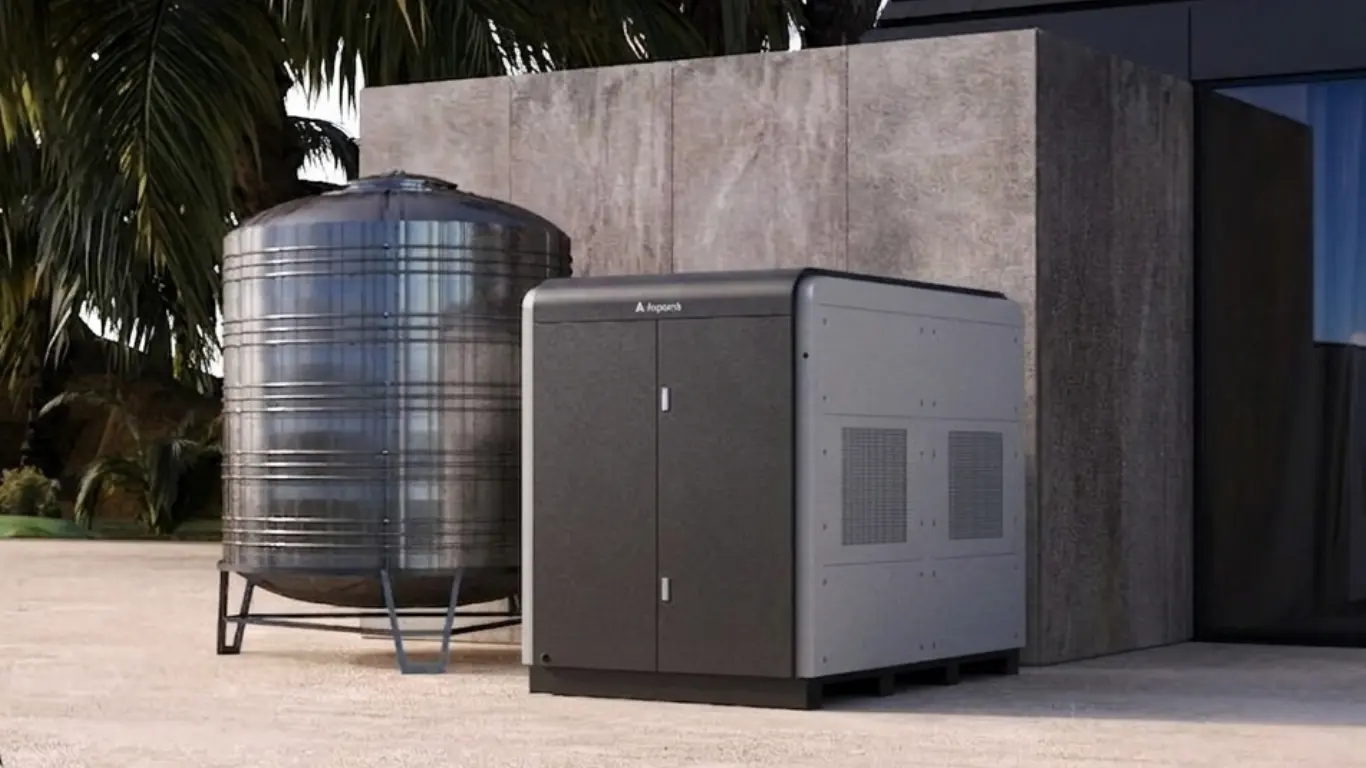
TL;DR -An atmospheric water generator (AWG) pulls drinking water from humidity in the air, condenses it, filters it, and pipes it into your home. The technology has matured, the per-gallon energy cost has dropped, and the real question for most buyers has shifted from "does this work?" to "does the math work for my situation?"
We field this question most often from Texas homeowners.
The conversation usually starts the same way: a slowing well, a fresh quote in the $50,000 to $100,000 range to drill a new one, and a hard look at whether there is a better path. This article lays out the full numbers so you can answer that for yourself. Upfront cost by tier, monthly electricity, cost per gallon, 10-year total cost of ownership, and how that stacks against the alternatives a real buyer is weighing: drilling a new well, water deliveries, bottled water, or staying on a municipal supply you don't fully trust.
For most homes on safe, reliable, cheap municipal water and no resilience concerns, an AWG is not the right purchase. We will say so plainly. For homeowners in Central Texas, Corpus Christi, Hill Country, the Florida Gulf Coast, California's Central Valley, and other markets where the well-drilling math has gone sideways, the AWG math is more interesting than it looks.
How Much Does an Atmospheric Water Generator Cost?
Residential AWGs span a wide range. Output, efficiency, and whole-home integration all move the price. The honest tiers, using Aquaria's Hydropack lineup as the reference points because the specs and prices are public:
Installation is separate.
A whole-home AWG that ties into existing plumbing typically runs $10,000 to $25,000 installed, depending on electrical work, plumbing routing, and whether storage tanks are added. Aquaria's financing program can roll the full installed cost into the monthly payment with $0 down and rates starting at 8.99%.
For comparison, smaller-output countertop or single-tap AWG units from other manufacturers tend to fall in the $1,500 to $6,000 range with output between 2 and 8 gallons per day. Those are a different category of product than a whole-home system. We treat them as a side note here because the math only really gets interesting at whole-home capacity.
What Does an AWG Cost to Operate Per Month?
Operating cost is dominated by electricity. Filter replacements add a smaller, predictable line item.
A Hydropack consumes 0.93 kWh per gallon (245 Wh/L) at rated conditions. A Hydropack S is slightly less efficient at 1.09 kWh per gallon (288 Wh/L). Multiplying by daily output and your utility rate gives the monthly power cost. The numbers below assume continuous production at average household demand for the model (a Hydropack S running closer to 30 gal/day, a Hydropack closer to 60 gal/day).
Filter replacement runs $100 to $200 per set every four to six months, which adds roughly $20 to $50 per month amortized.
If you pair an AWG with rooftop solar, the marginal electricity cost drops toward zero. That's the math homeowners with existing solar arrays should run carefully, because it changes the ten-year picture meaningfully.
What's the Cost Per Gallon of Water From an AWG?
Cost per gallon is the cleanest single number to evaluate AWG economics. It depends on two things: your utility rate and the system's efficiency in Wh/L.
For the Hydropack at 0.93 kWh/gal, at a US average residential electricity rate of $0.14 per kWh, the energy cost per gallon is approximately $0.13. That's the number New Atlas writer John Koetsier reached in his August 2024 piece, Making drinking water out of thin air. At lower utility rates ($0.08 to $0.10/kWh, common in the Pacific Northwest and parts of the South), the cost drops to $0.07 to $0.09 per gallon. At higher rates ($0.25 to $0.35/kWh, common in parts of California and New England), it climbs to $0.23 to $0.33 per gallon.
Plug-in drinking-water AWGs sit in the ~1.25 kWh/gal range, the Hydropixel included, which works out to about $0.17 per gallon at $0.14/kWh. As Koetsier noted in the New Atlas piece, that's still substantially cheaper than the $0.50 per gallon he was paying at his local grocery-store refill station.
These are energy costs only. Adding filters and amortized capital across the system's expected service life pushes the all-in cost per gallon to roughly $0.20 to $0.40 in most scenarios. The number that matters for the buying decision is not energy alone; it's the 10-year total below.
What's the 10-Year Total Cost of Ownership?
A ten-year TCO is the right planning horizon for evaluating a major home-infrastructure purchase. The Hydropack carries a 3-year manufacturer warranty; real-world ownership beyond that depends on filter changes and routine service, so ten years is used here as a defensible long-horizon planning number, not a guaranteed lifespan.
The table below assumes the Hydropack S (66 gal/day rated, producing roughly 30 gal/day in average conditions for a small household), Hydropack (132 gal/day rated, around 60 gal/day), and Hydropack X (264 gal/day, around 120 gal/day). Installation is assumed at $15,000, in the middle of the published range.
The numbers move significantly with utility rate, household demand, and whether the system is paired with solar. A solar-paired Hydropack with low marginal electricity cost can land closer to $0.15 to $0.20 per gallon all-in over ten years. A high-utility-rate household with above-average demand can push past $0.50 per gallon.
These are not the only numbers that matter. The next section compares them against what the alternatives cost.
How Does AWG Cost Compare to Drilling a Well, Water Deliveries, and Bottled Water?
Most AWG buyers are not comparing to municipal tap water. They're comparing to the actual cost they're facing right now.
Brian S., one of our customers in Texas, put the trade-off this way:
"I didn't want to put out $70,000 to drill a well when I could get into something like Aquaria."
The read on this table:
- If you have safe, reliable municipal water at $5 to $10 per 1,000 gallons, an AWG does not make economic sense. Tap water at municipal pricing is roughly $0.005 to $0.01 per gallon. Nothing in the AWG cost structure beats that, and we won't pretend otherwise.
- If you're facing a $40,000 to $80,000 well drill with no guarantee of hitting good water, the 10-year picture for an AWG starts looking very different. You're trading a known cost for a known cost, instead of gambling capital on geology.
- If you're spending $300+ per month on water deliveries or bottled water, the 10-year AWG total is competitive or favorable, and the experience is incomparable. Tap water from your own infrastructure, no plastic, no logistics.
- If you're treating a failing well with a $10,000 whole-house RO system and it's still not solving the underlying source-water problem, an AWG bypasses the well entirely. Different category, sometimes the right one.
For more on the well-drill side of this decision, your well running dry and what to do next walks through the cost path in detail, and AWG vs well water breaks down the direct head-to-head.
When Is an Atmospheric Water Generator NOT Worth the Cost?
Plainly:
- You're on safe, reliable, cheap municipal water and have no resilience concerns. Tap water is the cheapest water you'll ever drink. An AWG buys independence and purity, not affordability.
- You live in a low-humidity climate year-round (below 30% RH most of the year). AWG production falls off a cliff below 30% RH. Some Inland Mountain West and high-desert markets fall in this category.
- You can't run a 220V, 20-30A circuit at your panel. Whole-home AWGs draw real power. If your panel is at capacity and you're not willing to upgrade it, the install isn't viable.
- Your utility rate is above $0.35 per kWh and you don't have solar. At that rate, the cost per gallon climbs high enough that a quality whole-house filtration system or hauled water often makes more sense.
- You only need a few gallons a day for drinking, you're fine with municipal water for everything else, and you don't want a whole-home install. A countertop AWG or a high-quality RO under-sink system is the right answer at lower capital outlay.
We say this because credibility on the next paragraph depends on saying it here. An AWG is not a universal upgrade.
It's the right tool for a specific set of problems.
Can You Finance an Atmospheric Water Generator?
Yes. Aquaria's financing program offers $0 down, rates starting at 8.99%, and no payments for the first six months on approved credit. Terms run up to 20 years.
At those terms, a Hydropack lands at approximately $207 per month. A Hydropack S is roughly $137 per month. A Hydropack X is roughly $330 per month. Installation can be rolled into the financed amount, which is the right move for most buyers because it preserves cash for the rest of the project (storage tanks, electrical upgrades, plumbing tie-in).
The honest framing on financing: it doesn't change the total cost, only the cash-flow profile. The 10-year TCO numbers above still apply. What financing does is make the upfront comparison cleaner. $207 per month against $300 to $800 per month in water deliveries, or against a $40,000 well drill paid up front, is a much easier conversation than $22,499 cash today.
What to Do Next
If your current water situation is fine, do nothing. If your current situation is anything but fine, the right next step is to run your own numbers using the framework above. Plug in your utility rate, your household demand (gallons per day, not aspirational maximums), and your actual current water cost over 10 years.
If those numbers say an AWG might fit, the right next step is a 20-minute conversation, not a purchase. Book a call with an Aquaria Water Expert. We will walk through your utility rate, your household demand, your humidity profile, and your alternatives, and we will tell you honestly if atmospheric water generation makes sense for your situation. We will also tell you if it does not. Most readers will conclude one of three things: their current situation is fine and an AWG isn't needed, or filtration is the right intermediate step, or the math works and a Hydropack belongs in their stack. All three are correct answers.
Frequently Asked Questions
How much does an atmospheric water generator cost for a home?
A whole-home AWG costs $13,999 to $34,999 for the unit itself, plus $10,000 to $25,000 for installation, depending on output and complexity. Smaller countertop or single-tap AWGs run $1,500 to $6,000 and produce 2 to 10 gallons per day, suitable for drinking water only. Financing brings whole-home AWG payments to roughly $137 to $330 per month with $0 down.
Is an atmospheric water generator cheaper than tap water?
No. Tap water at typical US municipal rates costs about $0.005 to $0.01 per gallon. Water from a Hydropack costs about $0.13 per gallon in energy alone at a $0.14/kWh utility rate, per New Atlas's August 2024 review. AWGs are not designed to beat municipal water on price. They beat well drilling, water deliveries, and bottled water, and they deliver water quality municipal supplies often cannot.
What's the cost per gallon of an atmospheric water generator?
For a Hydropack at 0.93 kWh per gallon, the energy cost runs $0.07 to $0.33 per gallon depending on utility rate (from $0.08/kWh on the low end to $0.30/kWh on the high end). Adding filters and amortized capital costs typically brings the all-in 10-year cost per gallon to $0.27 to $0.47 across the model lineup. Solar pairing meaningfully reduces the energy line.
How much electricity does an AWG use per month?
A Hydropack running at average household demand (around 60 gal/day) draws roughly 1,650 kWh per month, costing $165 to $500 depending on utility rate. A Hydropack S at 30 gal/day draws about 980 kWh per month. A Hydropack X at 120 gal/day draws roughly 3,300 kWh per month.
Are atmospheric water generators worth the upfront cost?
It depends on what you're comparing them to. Yes for homeowners facing $40,000+ well drilling costs, $300+ per month in water deliveries, or significant municipal water quality issues; in those cases the 10-year total cost is competitive or favorable against the realistic alternative. No on pure economics for homeowners on safe, reliable, inexpensive municipal water; at that baseline an AWG buys water quality and independence, not savings. Both are defensible decisions; they answer different questions.
Can you finance an atmospheric water generator?
Yes. Aquaria's program offers $0 down, rates from 8.99%, and no payments for the first six months on approved credit. Hydropack S financing starts at $137 per month, Hydropack at $207 per month, and Hydropack X at $330 per month. Installation can be rolled in.
How long until an AWG pays for itself?
Payback depends entirely on what you're replacing. Versus $500 per month in water deliveries, a financed Hydropack pays back in roughly 6 to 8 years. Versus a $60,000 well drill, the math is favorable from day one because the alternative requires the full capital upfront with no production guarantee. Versus municipal water at municipal pricing, an AWG never "pays back" on cost alone; the case for ownership rests on resilience, water quality, and independence.
Subscribe to our Newsletter
Get the latest updates, news and insights directly to your inbox
No payments for 6 months on any Hydropack. Get your Hydropixel delivered free in the continental US.
Get Your Free Water Plan
Two quick steps. We'll send the right system size, expected output for your climate, and exact pricing — usually within one business day.