
TL;DR: Corpus Christi’s average residential water rate rose $4.78 per month and wastewater rose $4.20 per month on January 1, 2026, with a Level 1 curtailment plan (5,250-gallon residential limit, $4 surcharge per 1,000 gallons over 7,000, fines up to $500) potentially arriving as soon as September 2026. The 2026 rate increase isn’t a one-off, it’s part of a national trend: US water utility rates are up 43% over the past decade. Realistic homeowner alternatives include conservation (free, doesn’t fix reliability), drilling a well ($40K–$100K with no guaranteed water), bottled or delivered water ($100–$200+/month, not a long-term substitute), rainwater harvesting (drought-dependent), and atmospheric water generation, which produces drinking-grade water on-site, independent of reservoirs.
If you live in Corpus Christi, your water and wastewater bill went up by about $9 a month on January 1, 2026, and that’s before any drought surcharge kicks in. The bigger question isn’t the increase itself. It’s what the increase signals: a city paying more for water it’s still not sure it can deliver, and a homeowner being asked to pay more for less reliability.
This article walks through what actually changed in your bill, what’s likely coming next, and the alternatives a Corpus Christi family realistically has when the city water system gets squeezed harder.
Key facts to know before you read further
- The 2026 increase. The average residential water rate rose $4.78 per month and wastewater rose $4.20 per month as of January 1, 2026. The city says the money pays for infrastructure upgrades and additional water shipped through the Mary Rhodes Pipeline. (Source: City of Corpus Christi, Dec. 5, 2025.)
- The reservoirs. Lake Corpus Christi and Choke Canyon, the city’s two main reservoirs, have dropped to roughly 8% of combined capacity during the current drought, according to reporting by The Texas Tribune.
- The curtailment plan. The city is preparing a Level 1 emergency curtailment that could arrive as soon as September. Under the version water staff has proposed, residential customers would be limited to 5,250 gallons per month (about 25% cut from the average), with a $4 per 1,000 gallons surcharge above 7,000 and Class C misdemeanor fines up to $500 for violations.
- The national backdrop. US water utility rates are up 43% over the last decade, growing roughly three times faster than inflation (Bluefield Research). The American Society of Civil Engineers grades US water infrastructure at C-.
We’ve spent the last few years talking with homeowners across Texas about exactly this situation: the bill creeping up, the news getting worse, and nobody at the city giving a clean answer about whether the water will actually be there next summer. Here’s how we walk through it with them.
What changed in your bill?
Two things, technically.
First, the base monthly minimum for inside-city-limits residential service went up to $17.25, with the first 2,000 gallons priced into that minimum. Then the volumetric charges above 2,000 gallons stepped up, every additional 1,000 gallons through the next tiers, with the steepest jump at the highest block (over 25,000 gallons). Wastewater, billed based on a winter-quarter average, went up to a $38.29 monthly minimum inside city limits, with $8.41 per 1,000 gallons above the threshold. (Source: City of Corpus Christi 2026 Water Rate Schedule.)
For a household using the average 7,000 gallons a month, the combined water and wastewater increase works out to roughly $9 more per month, about $108 over the year. For a household using more than that, and roughly 30% of Corpus Christi homes do, the increase is steeper because the higher-volume tiers cost more per 1,000 gallons.
The city’s stated reason: pay for infrastructure upgrades and cover the cost of additional water moving through the Mary Rhodes Pipeline. In plain English, the city is paying more to get water from farther away, and passing that cost through.
Is this rate increase a one-time thing or the start of a trend?
It’s almost certainly the start of a trend.
Across the country, utility-level water rates are up 43% over the past decade, while electricity and natural gas have averaged closer to 1% per year (Bluefield Research). Water rates have been rising about three times faster than inflation (Water Sources Research). At the same time, the American Society of Civil Engineers rates US drinking-water infrastructure at C- and estimates the country needs more than $1 trillion in water-system investment in the coming decades.
That national trend lands hard in South Texas. Lake Corpus Christi and Choke Canyon, the two reservoirs the city depends on, are at about 8% of capacity. To keep taps running, Corpus Christi is shipping water down the Mary Rhodes Pipeline and helping fund a patchwork of emergency wells. Nearby cities, Alice, Beeville, Mathis, are drilling wells of their own. (Source: The Texas Tribune, “South Texas cities drilling wells to delay water crisis.”)
Every one of those moves has a cost. Pipelines, emergency wells, treatment upgrades, desalination studies, somebody has to pay for them, and that somebody is the rate-payer. The 2026 increase is one step in that pattern, not the end of it.
What happens if the curtailment plan passes?
In April 2026, Corpus Christi water staff presented a curtailment plan to City Council. (Source: Texas Tribune) The vote was delayed, but the framework gives a clear picture of what a Level 1 emergency would look like for a homeowner:
- A 25% reduction in residential use, about 6,000 gallons per month per household.
- A $4 surcharge for every 1,000 gallons used above a 7,000-gallon monthly threshold, affecting about 13% of Corpus Christi’s 91,000 residential customers right out of the gate.
- Violations treated as a Class C misdemeanor, subject to fines of up to $500.
- For a second violation, the city could cut off the customer’s water for at least one billing cycle.
To put that allowance in context: 6,000 gallons across a 30-day month is about 175 gallons per household per day. A standard older-spec toilet uses 3.5 gallons per flush. A 10-minute shower uses 20 to 25 gallons. Stop and picture a family of four sharing 175 gallons a day for a month, every load of laundry, every dishwasher run, every shower, every glass of water, and the line between “tight” and “over the limit” gets thin fast. (Our piece on what 6,000 gallons looks like at home walks through this scenario in more detail.)
There’s also a fairness wrinkle worth knowing about. Eight industrial water users, including Valero, Citgo, and Flint Hills Resources, bought into a drought surcharge exemption program years ago at $0.31 per 1,000 gallons. Residential customers don’t have that option. (Source: Texas Tribune.)
What are my actual alternatives as a homeowner?
This is the question that brings most people to us. The honest answer is that every option has tradeoffs. Here’s a side-by-side look at the realistic shortlist for a Corpus Christi family on city water today.
How does an atmospheric water generator actually help a Corpus Christi home?
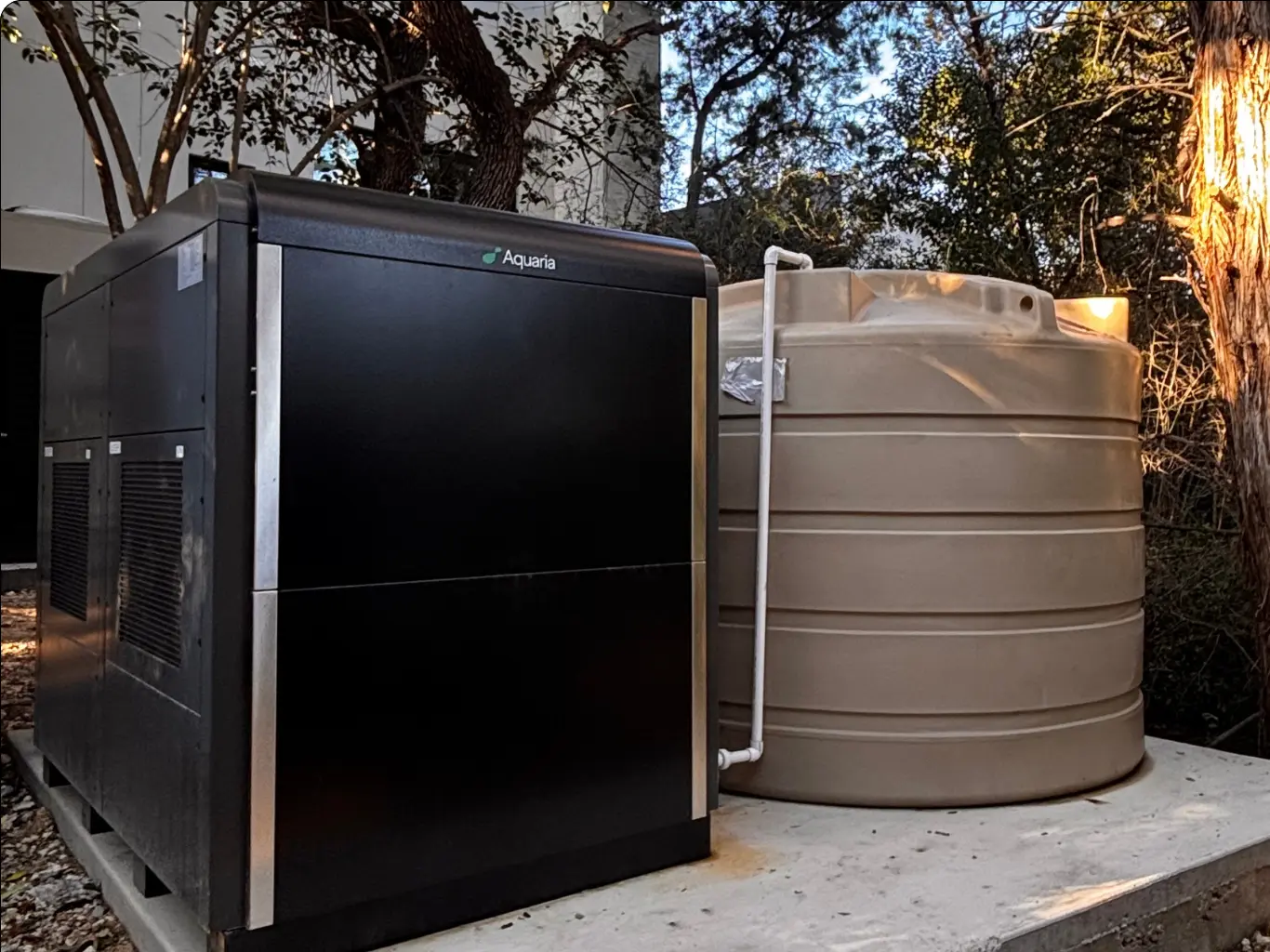
Think of it the way solar plus a Powerwall works for electricity. Solar panels generate power on-site so your home is less dependent on the grid, and a battery stores it so you have it when the grid is down. The Aquaria Hydropack does the same thing for water: generate from the air, store in your tank, draw down when you need it.
A few specifics from our verified system data:
- The Hydropack produces up to 132 gallons of clean drinking water per day at rated conditions, and the Hydropack X up to 264 gallons per day.
- It needs at least about 30% relative humidity to produce meaningfully. Corpus Christi, sitting on the Coastal Bend, runs well above that for most of the year. Gulf-influenced humidity is one of the reasons atmospheric water generation is a particularly good match for this part of Texas.
- Independent lab testing by SimpleLab, found Aquaria’s water at 4.54 mg/L total dissolved solids (typical tap water runs 200 to 400) and returned 92+ of 100+ tested contaminants as not detected. Pace Analytical separately tested for 14 PFAS compounds via EPA Method 537.1 and returned all 14 as not detected. (As with any lab test, these are results from specific tested samples, not a universal guarantee.)
This isn’t about replacing city water for everything. It’s about having a reliable on-site source for what matters most, your family’s drinking, cooking, and core household use, while the city water system handles the rest. When the curtailment letter arrives, the 5,250-gallon limit is a much easier number to live inside if your highest-quality water is coming from your own equipment.
Financing on the Hydropack starts at $207/month with $0 down, with installation costs that can be rolled into the same loan. For a homeowner already weighing a $70,000+ well drill, or rising bills with no ceiling, the math gets interesting quickly. If you want to know whether AWG is right for your home, check out guide here.
How do I figure out if it makes sense for my house?
Honestly, it depends on a handful of property-specific things: how much water your household actually uses, your electrical panel headroom, where the Hydropack and storage tank would sit, and how aggressive you want to be about replacing versus supplementing city water.
The right next step isn’t a purchase, it’s a conversation. Book a call with an Aquaria Water Expert. We’ll walk through your bill, your property, and your situation. We’ll tell you honestly whether atmospheric water generation makes sense for your home. We’ll also tell you if it doesn’t.
Frequently asked questions
Did Corpus Christi water rates go up in 2026?
Yes, and another increase is on the way. Effective January 1, 2026, the city's average residential water rate increased by $4.78 per month and the wastewater rate by $4.20 per month, per the City of Corpus Christi's December 5, 2025 announcement, citing infrastructure upgrades and additional water supply costs through the Mary Rhodes Pipeline.
A second increase is now expected later this year. In a May 29, 2026 briefing, City Manager Peter Zanoni said new rates could take effect as early as October 2026 — three months ahead of the usual January adjustment — and could be approved by City Council as soon as early August. The City Council has approved roughly $1 billion in water supply projects (not including desalination), and city officials have said the bulk of those costs will be carried by ratepayers. The exact amount of the next increase has not yet been finalized. (Source: Caller Times.)
When could drought curtailment fines start in Corpus Christi?
A Level 1 emergency could arrive as soon as September 2026, according to the city water department’s April 2026 presentation reported by The Texas Tribune. Under the proposed plan, residents would be limited to 5,250 gallons per month, with a $4 surcharge per 1,000 gallons above 7,000 and Class C misdemeanor fines up to $500 for violations. Council had not finalized the plan as of late April 2026.
How low are Lake Corpus Christi and Choke Canyon?
The two reservoirs, Corpus Christi’s primary water source, had fallen to roughly 8% of combined capacity during the current drought, according to Texas Tribune reporting.
Can an atmospheric water generator supply a whole Corpus Christi home?
In many cases, yes, though it depends on household size, daily use, and humidity. A Hydropack produces up to 132 gallons per day at rated conditions; a Hydropack X up to 264 gallons per day. Corpus Christi's coastal climate runs well above the ~30% relative humidity threshold AWG needs most of the year, which makes it one of the better Texas markets for an on-site air-to-water source.
Most Corpus Christi homeowners pair their Aquaria system with city water rather than replacing it outright: Hydropack water covers drinking, cooking, and core household use; city water handles the rest. That setup gives you an independent, on-site source for your highest-value uses while reducing exposure to municipal rate increases; which, per the city, are expected again as early as October 2026 and will continue as the $1B in approved water supply projects come online.
Sizing depends on your specific household. The best next step is a quick call with an Aquaria Water Expert to map your usage to the right configuration.
Is water from an atmospheric water generator safe to drink?
Yes, based on independent third-party testing. Microbac Laboratories testing of Aquaria’s water found total dissolved solids of 4.54 mg/L and 92+ of 100+ tested contaminants as not detected. Pace Analytical separately tested 14 PFAS compounds via EPA Method 537.1 and returned all 14 as not detected. These are results from specific test samples, not a universal guarantee, but they reflect a consistent pattern across third-party testing.
Subscribe to our Newsletter
Get the latest updates, news and insights directly to your inbox
No payments for 6 months on any Hydropack. Get your Hydropixel delivered free in the continental US.
Get Your Free Water Plan
Two quick steps. We'll send the right system size, expected output for your climate, and exact pricing — usually within one business day.