
TL;DR: More than 23% of private wells in the US have at least one contaminant at levels that pose a health risk, and no federal agency regulates or tests them. The most common threats are arsenic, nitrates, bacteria, PFAS, and radon. Testing is the only way to know what is in your water, and the solution depends on what you find.
If you rely on a private well, the quality of your water is your responsibility. Unlike municipal systems, private wells are not regulated by the Safe Drinking Water Act, not monitored by the EPA, and not required to be tested. According to the USGS, more than 23% of private domestic wells in the United States contain at least one contaminant at levels of potential health concern. That is roughly 10 million of the 43 million Americans who depend on well water.
The challenge is that well water contamination is usually invisible. You cannot taste arsenic at dangerous levels. You cannot smell PFAS. Nitrates have no color. By the time you notice something wrong, like a change in taste, staining on fixtures, or unexplained health symptoms, the contamination may have been there for months or years.
Aquaria's Hydropack systems address this problem from a fundamentally different angle. Instead of treating contaminated groundwater, a Hydropack pulls water from the humidity in the air, bypassing the well, the aquifer, and every contaminant in the ground. But understanding what is actually in your well water comes first, because the right solution depends on the type and severity of what you are dealing with.
What Are the Most Common Contaminants in Well Water?
Private wells face contamination from both natural geological sources and human activity. The EPA and USGS have identified several categories that appear most frequently:
Arsenic. Naturally present in rock formations across much of the US, particularly in Texas Hill Country, California's Central Valley, New England, and parts of the Midwest. Arsenic is a known carcinogen linked to skin, bladder, and lung cancer. The EPA's maximum contaminant level (MCL) is 10 parts per billion (ppb), but many private wells exceed this without the owner knowing.
Nitrates. Primarily from agricultural fertilizer runoff and septic system leakage. Nitrate contamination is especially prevalent in farming regions and areas with dense septic infrastructure, like much of rural Florida. At high levels, nitrates cause methemoglobinemia ("blue baby syndrome") in infants, a condition that can be fatal. The EPA MCL is 10 mg/L.
PFAS ("forever chemicals"). PFAS contamination in groundwater comes from industrial discharge, firefighting foam, landfills, and biosolids spread on farmland. The USGS found that 45% of US drinking water contains at least one PFAS compound. The EPA set enforceable limits at 4 parts per trillion (ppt) for PFOA and PFOS in 2024, but 40 million Americans on private wells have zero PFAS monitoring. You cannot know your PFAS exposure without specific, laboratory-grade testing.
Bacteria (E. coli, total coliform). Surface water intrusion, failing well casings, and nearby septic systems can introduce bacteria into well water. Bacterial contamination is often intermittent, appearing after heavy rain or flooding and then subsiding. A single clean test does not mean your well is permanently safe.
Lead. Typically from old plumbing, solder, or well components rather than the aquifer itself. Lead exposure causes neurological damage in children and kidney damage in adults. There is no safe level of lead in drinking water.
Iron, manganese, and sulfur. These are nuisance contaminants rather than health threats at typical levels. Iron causes orange staining, manganese leaves black deposits, and hydrogen sulfide produces the rotten-egg smell common in Florida and parts of Texas. They make life unpleasant and corrode plumbing, but they are not the contaminants that should concern you most.
Radon. A radioactive gas that dissolves in groundwater and is released when water is used, particularly during showers. The USGS found radon at concerning levels in crystalline rock aquifers across the Northeast, Appalachia, and parts of Colorado. Radon is the second leading cause of lung cancer in the US.
How Do You Know If Your Well Water Is Contaminated?
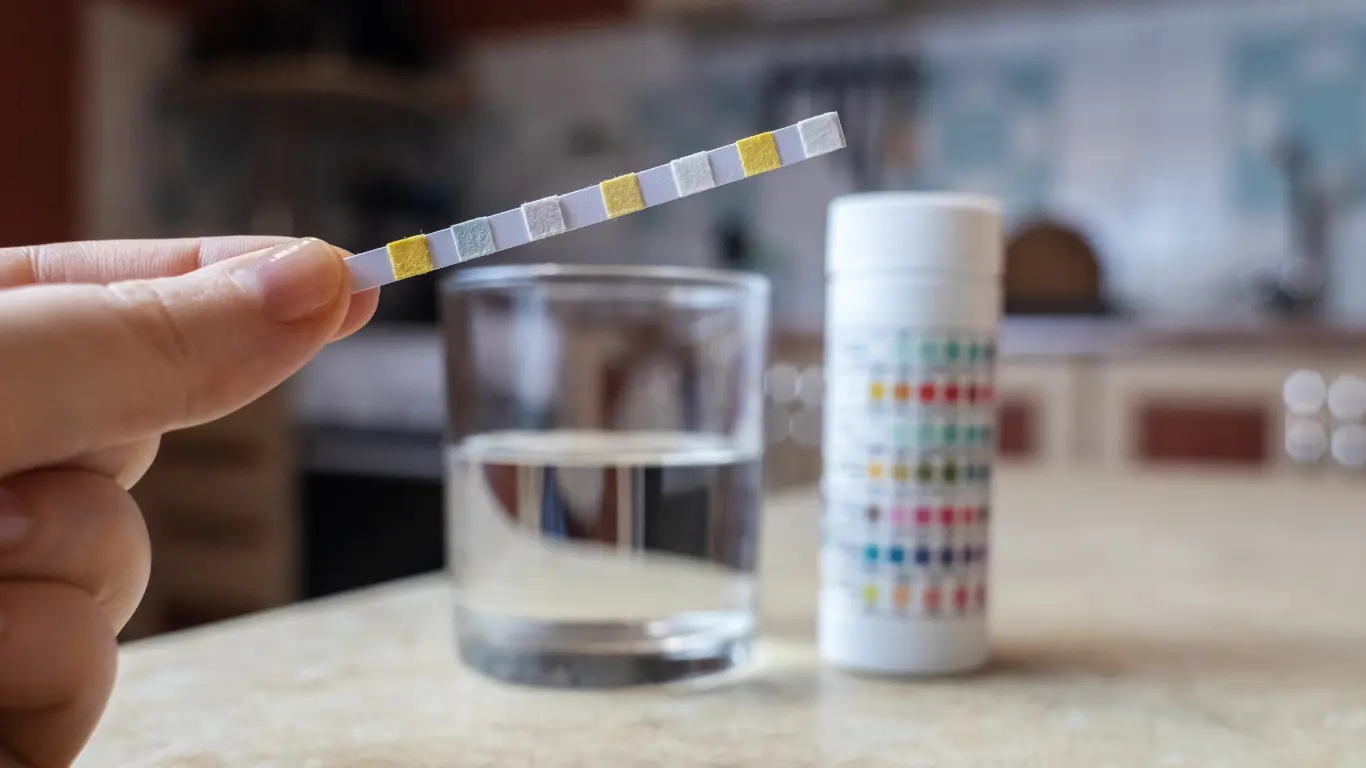
Testing is the only reliable answer. The CDC recommends testing private wells at least once a year for total coliform bacteria, nitrates, TDS, and pH. Additional testing for arsenic, PFAS, VOCs, and other contaminants should be done based on your region and local risk factors.
Signs that warrant immediate testing:
- Change in taste, color, or odor
- Staining on fixtures, laundry, or dishes (orange = iron, black = manganese)
- Gastrointestinal illness in household members, especially after rain
- Nearby construction, agricultural activity, or industrial operations
- Flooding or standing water near the wellhead
- Your well is less than 50 feet deep (shallow wells are more vulnerable)
Where to get tested:
- State-certified laboratories (find yours through your state health department)
- Home test kits ($20 to $50 for basic panels, $150 to $400 for comprehensive panels including PFAS)
- Professional water testing services ($50 to $250 for in-home testing)
A comprehensive well water test that includes metals, bacteria, nitrates, VOCs, and PFAS typically costs $200 to $400 through a certified lab. Given that PFAS testing alone often runs $150 to $300, a full panel is worth the investment.
What Can You Do About Contaminated Well Water?
Your response depends entirely on what the tests reveal. There is no single solution for all types of contamination.
For specific contaminants at moderate levels (treatable):
ContaminantTreatment OptionApproximate CostBacteriaUV disinfection or chlorination$500 to $2,000 installedNitratesReverse osmosis (point-of-use)$250 to $1,100 installedArsenicWhole-house adsorption media filter$1,500 to $4,000 installedIron/manganeseOxidation filter or water softener$800 to $3,000 installedPFASActivated carbon or RO (NSF 53/58 certified)$300 to $1,500 installedLeadPoint-of-use RO or replace plumbing$250 to $5,000+HardnessWater softener$600 to $3,000 installed
For a deeper look at how reverse osmosis compares to other approaches for well water, see AWG vs Reverse Osmosis: Which Delivers Safer Water?.
For multiple contaminants or worsening conditions:
When your well water tests positive for several contaminants, the treatment stack becomes complex and expensive. A household dealing with arsenic, PFAS, bacteria, and hardness might need a sediment pre-filter, an arsenic media filter, a UV system, a water softener, and a point-of-use RO for drinking water. That stack can run $5,000 to $15,000 installed, with $500 to $1,500 in annual maintenance across all the systems.
At that level of investment, the question shifts from "how do I treat this water?" to "should I still be using this water source at all?"
For aquifer-level problems (not treatable at the tap):
Some contamination cannot be practically filtered at the residential level, or the source is degrading over time:
- Saltwater intrusion (aquifer permanently compromised)
- Aquifer depletion (well producing less water each year)
- Regional PFAS contamination from industrial sources (concentrations may increase)
- Agricultural nitrate loading that worsens with each growing season
In these cases, the well itself is the problem. No amount of filtration changes a depleted or permanently contaminated aquifer.
When Does It Make Sense to Bypass the Well Entirely?
For homeowners whose contamination is treatable and stable, filtration is the practical answer. But when the aquifer is the problem, not just the water in it, a different water source makes more sense than layering filter on top of filter.
Aquaria's Hydropack systems produce water by condensing humidity from the air. The water never contacts the ground, never passes through contaminated rock formations, and never carries the contaminants that accumulate in aquifers over decades. In independent lab testing by Microbac Laboratories, Pace Analytical, and EMSL Analytical, Hydropack water showed zero detectable PFAS (0 of 14 compounds tested), zero microplastics across all six size classes, zero lead, zero arsenic, zero nitrates, zero bacteria, and a TDS of just 4.54 mg/L. For comparison, typical well water ranges from 200 to over 1,000 mg/L TDS.
The Hydropack S produces up to 66 gallons per day and starts at $13,999 (or $137/month with financing, $0 down). The standard Hydropack produces up to 132 gallons per day at $22,499 ($207/month). Both connect directly to your home's existing plumbing, serving every tap, not just one faucet.
For homeowners who have already spent thousands on well drilling, water treatment systems, and ongoing maintenance, and whose water quality is still unreliable, the math often favors a single system that produces clean water from a source that is not getting worse. As one Texas Hill Country homeowner put it: "I didn't want to put out $70,000 to drill a well when I could get into something like Aquaria."
The comparison is not Hydropack versus a $300 kitchen RO filter. It is Hydropack versus the total cost of a well that may need a new pump ($1,500 to $5,000), annual water testing ($200 to $400), a whole-house treatment stack ($5,000 to $15,000), and the possibility of drilling a deeper or new well at $40,000 to $100,000+ if contamination reaches beyond what filtration can handle.
If your well water tests show concerning results and you want to understand whether a Hydropack fits your property and local humidity conditions, schedule a conversation with an Aquaria advisor.
Frequently Asked Questions
How often should I test my private well water?
At least once a year for bacteria, nitrates, TDS, and pH, per CDC guidelines. Test more frequently if you have a shallow well (under 50 feet), live near agricultural land, have experienced flooding, or notice any change in taste, color, or smell. PFAS testing should be done at least once to establish a baseline, especially if you live near military bases, airports, or industrial sites where firefighting foam has been used.
Can well water contamination make you sick?
Yes. The USGS found that more than 23% of private wells have at least one contaminant at levels of potential health concern. Acute effects from bacteria or nitrates can appear within days. Chronic effects from arsenic, PFAS, lead, and radon develop over months or years of exposure and include increased cancer risk, neurological damage, thyroid disruption, and immune system effects. Because symptoms often develop slowly, many well owners are exposed for years before they connect health issues to their water.
Does boiling well water make it safe?
No, not for most contaminants. Boiling kills bacteria and parasites, but it does not remove arsenic, nitrates, PFAS, lead, heavy metals, or VOCs. In fact, boiling concentrates dissolved contaminants because the water volume decreases while the contaminants remain. Boiling is only appropriate for short-term bacterial advisories, not for chemical contamination.
Is PFAS in well water dangerous?
Yes, at levels above the EPA's 2024 enforceable limits of 4 ppt for PFOA and PFOS. However, the EPA's maximum contaminant level goal for both is zero, meaning any detection exceeds the health target. PFAS exposure has been linked to thyroid disease, immune dysfunction, reproductive issues, and certain cancers. Forty million Americans on private wells have no mandatory PFAS monitoring, which means the only way to know your exposure is to test specifically for PFAS using EPA Method 537.1 or equivalent.
What does it cost to treat contaminated well water?
It depends on the contaminant. A single-contaminant solution like a point-of-use RO for nitrates costs $250 to $1,100. A whole-house treatment stack for multiple contaminants (arsenic, PFAS, bacteria, hardness) can run $5,000 to $15,000 installed, with $500 to $1,500 in annual maintenance. For comparison, a Hydropack S that bypasses the well entirely starts at $13,999 ($137/month with financing), requires $200 to $400 per year in filter replacements, and produces lab-verified clean water from the air.
Can atmospheric water generation replace a contaminated well?
Yes. Aquaria's Hydropack systems produce 66 to 264 gallons of water per day from atmospheric humidity and connect directly to home plumbing. In independent lab testing, Hydropack water showed zero detectable PFAS, microplastics, lead, arsenic, nitrates, and bacteria, with a TDS of 4.54 mg/L. Because the water source is the air, not the ground, aquifer contamination is not a factor. A storage tank paired with the system provides 2 to 3 days of buffer for consistent household supply.
Does a whole-house water filter remove all contaminants from well water?
No single filter removes everything. Activated carbon removes chlorine, VOCs, and some PFAS. Reverse osmosis removes dissolved solids, nitrates, and heavy metals. UV systems kill bacteria. Iron filters address iron and manganese. Each contaminant requires a specific treatment technology. That is why heavily contaminated wells often need multiple systems stacked together, which adds to both cost and complexity. For a detailed comparison of filtration technologies, see AWG vs Reverse Osmosis: Which Delivers Safer Water?.
Subscribe to our Newsletter
Get the latest updates, news and insights directly to your inbox
No payments for 6 months on any Hydropack. Get your Hydropixel delivered free in the continental US.
Get Your Free Water Plan
Two quick steps. We'll send the right system size, expected output for your climate, and exact pricing — usually within one business day.