
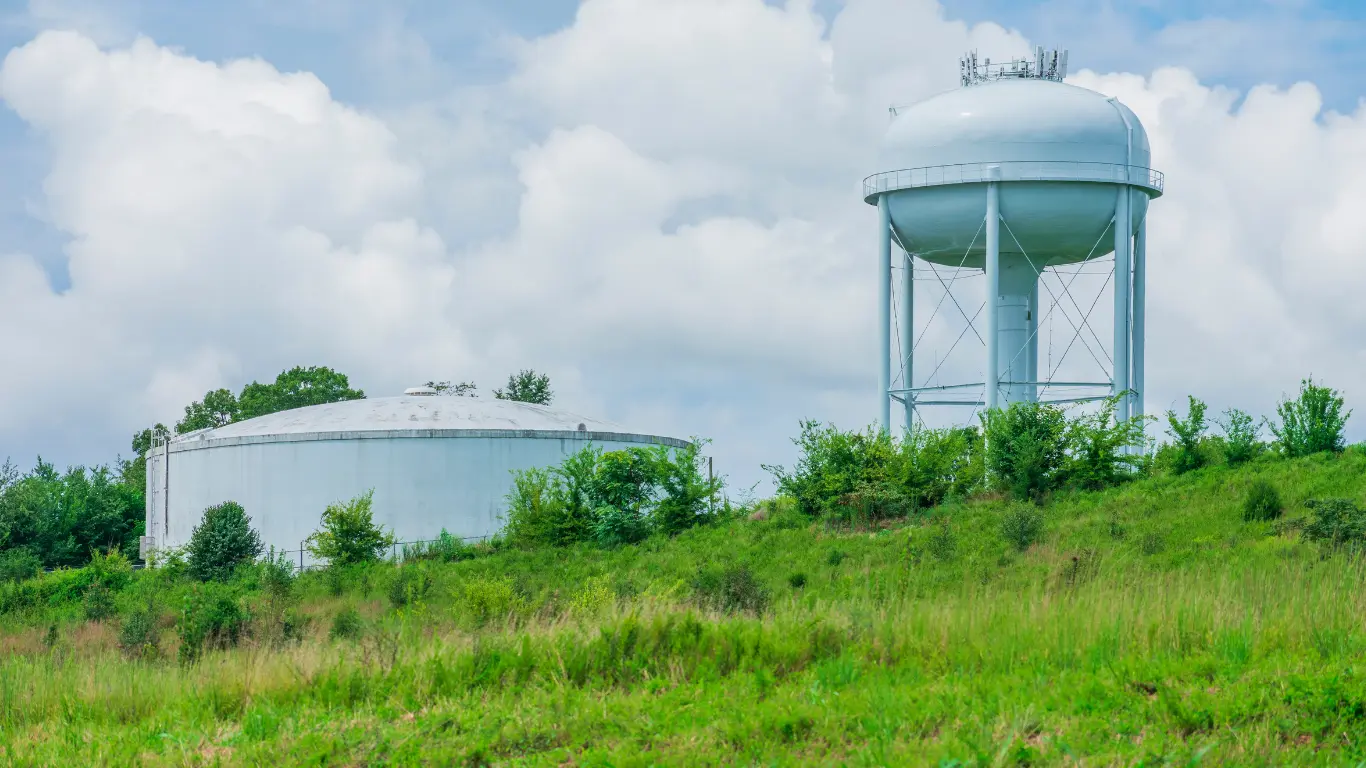
TL;DR: Choose city water if your municipal supply is reliable, tests below the EPA's PFAS limit of 4 parts per trillion, and you don't mind paying $40 to $120 a month and rising. Choose well water if your property has a documented aquifer, you can absorb the upfront $20,000 to $80,000 to drill, and you're prepared to test and maintain it yourself. Choose neither if both options fail your specific situation, which happens more often in 2026 than most homeowners realize.
If you're standing in front of this decision, you're usually doing it for one of three reasons. You're buying a property and choosing between a connected lot and a rural one. Your existing well is failing, and the city is willing to extend service for a five-figure tap fee. Or you're already on city water, watching your bill climb and your water quality reports get longer, and you're wondering if drilling a well is the smarter long-term move.
This guide is built around those three decisions. The cost numbers, the safety numbers, and the failure modes are the same; what changes is which ones matter for your situation. We'll walk through both systems honestly, then give you a decision tree you can run against your own property, and finally cover the third option that's reshaping this question in 2026: producing your own water on-site, independent of either source.
What's actually different between well water and city water?
Well water comes from groundwater your property pumps directly through a private well. You own it, you maintain it, and you decide what gets done to it before it reaches your tap. City water comes from a municipal utility that draws from rivers, reservoirs, or regional aquifers, treats it at a central plant, and delivers it through pipes to your meter. The utility owns the system up to your property line, you pay a metered rate, and the U.S. Environmental Protection Agency regulates what's in it under the Safe Drinking Water Act.
Three differences drive every other tradeoff downstream:
- Who's responsible for safety. City water is tested by the utility under federal and state law. Well water is tested by you, voluntarily, with no agency involved unless something goes catastrophically wrong. The U.S. Environmental Protection Agency confirms in its "Private Drinking Water Wells" guidance (September 2024) that private well water is not regulated under the Safe Drinking Water Act, full stop.
- How costs are structured. City water has a low upfront cost (a connection fee, a meter) and an ongoing monthly bill. A private well has a high upfront cost ($20,000 to $80,000 to drill in most U.S. markets, more in difficult geology) and very low ongoing operating costs once it's working.
- What can break. City water depends on the utility's pipes, treatment plant, and source supply. Wells depend on your aquifer, your pump, your pressure tank, and your filter stack if you have one. The two systems fail in completely different ways, on completely different timelines.
Everything else (taste, hardness, contamination risk, regulatory exposure) flows from those three.
How much does well water cost compared to city water?
City water costs the average U.S. household between $40 and $120 a month, depending on the city and how much water you use. Well water costs almost nothing per month to operate (typically $5 to $20 in pump electricity), but the upfront drilling cost runs $20,000 to $80,000, with difficult-geology wells going significantly higher. Across a 20-year ownership horizon, the two paths often land within a few thousand dollars of each other; the difference is when you pay.
Here's what each path actually costs in 2026:
City water, 20-year breakdown:
- Connection / tap fee: $1,500 to $20,000 depending on the municipality (higher in growing markets where utilities are recovering capacity costs)
- Monthly bill: $40 to $120, rising at roughly 3 percent per year (U.S. water rates have grown 43 percent over the last decade according to Bluefield Research, faster than electricity or natural gas)
- 20-year operating total: $14,000 to $42,000
- 20-year all-in: $15,500 to $62,000
Private well, 20-year breakdown:
- Drilling and casing: $20,000 to $80,000 (typical U.S. range; harder geology, deep aquifers, or low-yield wells push to $100,000+)
- Pump and pressure tank: $1,500 to $4,000, replaced once or twice over 20 years
- Filter stack (most wells need at least sediment + carbon, many need more): $2,500 to $18,000 installed, plus $700 to $1,800 a year in maintenance
- Annual testing: $30 to $200 per panel, recommended yearly by the U.S. Centers for Disease Control and Prevention
- Pump electricity: $60 to $240 per year
- 20-year all-in: $35,000 to $90,000
Two takeaways from those numbers. First, a "free" private well is not free; the drilling and the filter stack do the heavy lifting that a city utility does invisibly. Second, city water doesn't stay $40 a month forever. The American Society of Civil Engineers gave U.S. drinking water infrastructure a C- in its 2025 "America's Infrastructure Report Card: Drinking Water" assessment, and the rate increases needed to fix that infrastructure are showing up on residential bills now.
The honest comparison is not "well water is cheaper" or "city water is cheaper." It's that one path front-loads the cost and the other spreads it.
Which is safer, well water or city water?
City water is safer by default because someone is testing it for you. Well water can be just as safe, or significantly safer, if you test it consistently and treat it appropriately. The reason most well water in the U.S. is less safe than city water is not that wells are inherently dirty; it's that most well owners don't test on schedule.
The U.S. Centers for Disease Control and Prevention recommends in its "Drinking Water from Private Wells" guidance (April 2024) that private well owners test annually for total coliform bacteria, nitrates, total dissolved solids, and pH, and additionally for any contaminant of concern in the local area. Most don't. The U.S. Geological Survey reported in "Per- and Polyfluoroalkyl Substances (PFAS) in U.S. Drinking-Water Supply" (July 2023) that 40 million Americans rely on private wells with no mandatory PFAS monitoring.
Where each system is most exposed:
City water risks are infrastructure-driven. Lead service lines, aging treatment plants, and pipe breaks introduce contamination after the water leaves the plant. The U.S. Environmental Protection Agency set enforceable PFAS limits of 4 parts per trillion for PFOA and PFOS in its April 2024 "PFAS National Primary Drinking Water Regulation," and the same USGS analysis found PFAS in 45 percent of U.S. drinking water samples. If your utility's annual Consumer Confidence Report shows detection of any regulated contaminant, that's the floor for what reaches your tap; aging pipes can add to it.
Well water risks are source-driven. Agricultural runoff, septic system contamination, saltwater intrusion in coastal areas, naturally occurring arsenic in Texas Hill Country, California Central Valley, and parts of New England, and bacterial contamination after flooding. Wells in industrial areas or near former gas stations face VOC and petroleum risks. The list looks long because every well is in a different setting; most wells face only two or three of these risks, but you have to test to know which ones.
The practical safety question for both paths is the same: what does the test report say? For city water, that's the utility's annual Consumer Confidence Report (free, mailed or posted online by July of each year). For well water, it's the panel from a state-certified lab, paid for and ordered by you. Both paths can hit safe-to-drink standards. Both can fail. The difference is whether someone else is checking.
When does each system fail?
Both systems can deliver clean water for decades. Both can also fail unexpectedly, and the failure modes don't look anything alike.
City water fails through infrastructure events. Pipe breaks, treatment plant outages, contamination events, freezes that crack distribution mains. The 2021 Texas freeze left millions without water for days. Jackson, Mississippi has had repeated multi-week outages. Boil water notices are routine in many U.S. cities multiple times a year. When city water fails, it tends to fail fast and affect everyone on the same system, then come back when the utility fixes the problem.
Well water fails through depletion or contamination. The aquifer drops, the pump can't reach it, and yield falls until the well goes dry. The United Nations University Institute for Water, Environment and Health found in its 2026 "Global Water Bankruptcy Report" that 70 percent of the world's major aquifers show long-term declining trends, and aquifer depletion is well documented in the Texas Hill Country, the California Central Valley, and the High Plains. Or the well stays wet but starts testing positive for something it didn't have before: saltwater intrusion in a coastal county, nitrates after a neighbor expands their feedlot, bacteria after a flood.
Failure timelines are different too. A city water outage usually lasts hours or days. A well that's running dry gives months of warning (declining yield, longer pump cycles, sand in the water) before it stops producing entirely. Drilling a new well takes weeks at minimum and can stretch to months in a busy market or difficult geology. A contaminated well can be filtered, but only if the contamination is something a residential filter can handle.
For a decision guide, the takeaway is this: city water has a higher failure frequency but shorter outages. Wells have a lower failure frequency but, when they do fail, the recovery is harder, slower, and more expensive.
Which option is right for your property?
Run this decision tree against your specific situation. It's built on the cost and risk numbers above, not on generic advice.
Start here: Is city water available at the property line, with a tap fee under $10,000?
- Yes → city water is almost always the right call unless your municipal supply has a documented contamination or reliability issue. Read the utility's most recent Consumer Confidence Report before you commit. If the report shows PFAS detection above the EPA's 4 ppt limit, lead violations, or repeated boil water notices, your decision is no longer simple; see the "neither" path below.
- No → continue.
If you'd be drilling a new well: Has a hydrogeologist or local well driller confirmed an aquifer at a reasonable depth (under 400 feet for most U.S. markets)?
- Yes, with a yield estimate above 5 gallons per minute → drilling is viable. Budget $20,000 to $80,000 and proceed if you can absorb the upfront cost.
- Yes, but yield is marginal (under 5 gpm) or depth is significant → drilling is high-risk. Marginal wells often need cisterns and supplemental sources. Talk to the well driller about cost-of-failure clauses; many will quote dry-hole risk.
- No, or unknown → drilling without an aquifer assessment is a coin flip. The U.S. Geological Survey's groundwater data and your state geological survey are the right starting points before you pay a driller.
If your existing well is failing: How old is the pump, what's the test report saying, and how deep would a new well need to go?
- Pump is 15+ years old, test report is clean, yield is declining slowly → replace the pump, pressure tank, and any worn fittings. Cheapest path, often $3,000 to $6,000.
- Test report shows contamination that filters can address (hardness, iron, sediment, taste) → a filter stack is $2,500 to $18,000 installed depending on contaminants. See Well Water Filters: Types, Costs, and How to Choose for the full breakdown.
- Aquifer is dropping, neighbors are losing wells too, or contamination is severe (PFAS, arsenic, saltwater intrusion) → drilling deeper is a gamble, and filters won't reach the EPA's PFAS limits at residential scale. This is where the third path matters.
If both options have problems (city water that's expensive and contaminated, or a property where drilling is risky and filters can't keep up), neither is the right answer. That's a real situation, and it's more common in 2026 than it was a decade ago.
What's the third option for homeowners both paths fail?
An atmospheric water generator (AWG) condenses water from humid air rather than drawing it from a municipal source or the ground. It's a real third path: not bottled water, not a filter, not a water delivery service. Aquaria's Hydropack is one of the few residential AWGs designed for whole-home plumbing integration, producing between 66 and 264 gallons per day depending on which model and how humid the local air is. Think of it the way solar plus a Powerwall replaced the electric utility for energy: a Hydropack plus a storage tank does the same thing for water, with the source moving from the ground or the municipal grid to the air on your property.
The case for AWG over either well or city water isn't that one is universally better. It's that AWG addresses a different problem: source quality and reliability. If your aquifer is declining, no filter can produce more water. If your municipal water has PFAS at levels a whole-house carbon filter can't reach, AWG bypasses the regulated supply entirely. The water is condensed from humidity, not drawn from the ground or piped from a treatment plant.
Independent lab testing tells the practical version of that story. Three independent labs (Microbac Laboratories, Pace Analytical, and EMSL Analytical) tested water from a Hydropack in Austin, Texas. The Microbac panel of 100-plus contaminants showed non-detect for lead, arsenic, nitrates, iron, fluoride, chloride, total coliform, and E. coli. The Pace Analytical PFAS panel ran 14 PFAS compounds, including PFOA and PFOS; all returned non-detect. The EMSL microplastics panel ran six size classes; no microplastics found. Total dissolved solids came in at 4.54 mg/L, compared to 100 to 400 mg/L in typical tap water and 20 to 200 mg/L in most bottled water. These are tested-sample results, not universal guarantees, and the same testing protocol applies to every Hydropack delivered.
Where AWG fits and where it doesn't:
A Hydropack with financing puts the monthly cost in the same range as a high-end city water bill plus a filter stack ($137 to $330 a month depending on model), with no tap fee, no drilling risk, and no dependency on a single source. The Aquaria app handles the operational side, scheduling production around peak humidity hours, surplus solar generation, or off-peak electricity rates so the system runs against the cheapest power available. It's not the right answer for most homeowners on a clean municipal supply. It is the right answer when both traditional options have failed your specific situation.
What's a reasonable next step?
Pull your facts before you decide.
If you're considering city water, get the most recent Consumer Confidence Report from the utility and read the contaminant detection table. If you're considering a well, get a state-certified water test on any existing source and a yield estimate from a local well driller before you sign anything. If you're already on city water and frustrated with bills or quality, run the 20-year math against the upfront cost of a well in your geology before you assume drilling saves money.
If your situation looks like the bottom three rows of the table above (failing well, contaminated municipal supply, or off-grid property), see how the Hydropack fits your home before you sink another five figures into a path that isn't going to solve the underlying problem.
For more on how a private well's filter stack compares against the cost of replacing the source, see our Well Water Filters: Types, Costs, and How to Choose breakdown. For the specific question of PFAS contamination on a private well, see Well Water Contamination: What's in Your Water and What to Do About It.
Frequently asked questions
Is well water cheaper than city water in the long run?
Sometimes. It depends on drilling cost. In markets where wells run $20,000 to $40,000 and the geology is favorable, a private well usually costs less than city water across a 20-year horizon. In markets with deep aquifers or difficult geology where wells run $50,000 to $80,000+, city water is often cheaper across the same horizon, especially when filter stack costs are included.
Is well water safer than city water?
No, not by default. City water is regulated and tested by the utility under the U.S. Environmental Protection Agency's Safe Drinking Water Act. Well water is the owner's responsibility and is only as safe as the testing and treatment regimen you maintain. A diligent well owner with a clean test report and proper filtration typically has water as safe as, or safer than, an average municipal supply. A well owner who has not tested in five years has no way of knowing.
How often should I test my well water?
Annually for total coliform bacteria, nitrates, total dissolved solids, and pH, per the U.S. Centers for Disease Control and Prevention's standing guidance. Test additionally for any contaminant of concern in your area (PFAS, arsenic, lead, VOCs, agricultural pesticides), and after any flood, earthquake, or work on the well itself.
Can I switch from a well to city water?
Yes, if city service is available at your property line. The cost is the connection / tap fee (typically $1,500 to $20,000 depending on the municipality) plus the plumbing work to tie your house into the new service. Some municipalities require you to abandon and seal the well permanently; others allow you to keep it for irrigation. Check with your local utility and county health department before you commit.
Can I switch from city water to a well?
Yes, if the property has a viable aquifer. The cost is drilling and casing the well ($20,000 to $80,000+), installing a pump and pressure tank ($1,500 to $4,000), running a filter stack appropriate to your test results ($2,500 to $18,000+ installed), and paying any disconnection or capping fees the utility requires. A hydrogeologist's aquifer assessment ($500 to $2,000) is worth the spend before you commit.
What if my property has neither viable city water nor a viable aquifer?
This is the situation an atmospheric water generator was designed for. The Hydropack produces 66 to 264 gallons of household water per day from humid air, with no source-water dependency. It's not the right answer for a homeowner with clean, affordable city water, but it's a real path for off-grid properties, failing-aquifer regions, and contaminated municipal supplies where neither traditional option works.
Subscribe to our Newsletter
Get the latest updates, news and insights directly to your inbox
No payments for 6 months on any Hydropack. Get your Hydropixel delivered free in the continental US.
Get Your Free Water Plan
Two quick steps. We'll send the right system size, expected output for your climate, and exact pricing — usually within one business day.