
TL;DR -- Rainwater collection is limited less by total rainfall than by how large a storage tank you're willing to install, while an atmospheric water generator (AWG) draws from humidity in the air and produces water on a schedule you can plan around. An Aquaria Hydropack produces that much in about two months. The right answer depends on your roof, your rainfall, your storage budget, and whether you want water that's opportunistic or predictable.
If you have been looking at rainwater collection because your well is unreliable, city water rates keep climbing, or you just want a source of water you actually control, you're asking the right question. Rainwater is a genuinely good option, but it has one hard limit that has nothing to do with how often it rains: how big a tank you're actually willing to put on your property.
We have spent the last few years talking with homeowners across Texas who bought rain harvesting systems, installed storage tanks, then watched their tanks go empty six months into the year. Here is what we tell people who ask us how atmospheric water generation compares.
What are you actually comparing?
Rainwater collection and atmospheric water generation both answer the same broader question: how do you get water that doesn't come from a well or a utility. Beyond that, they are very different technologies.
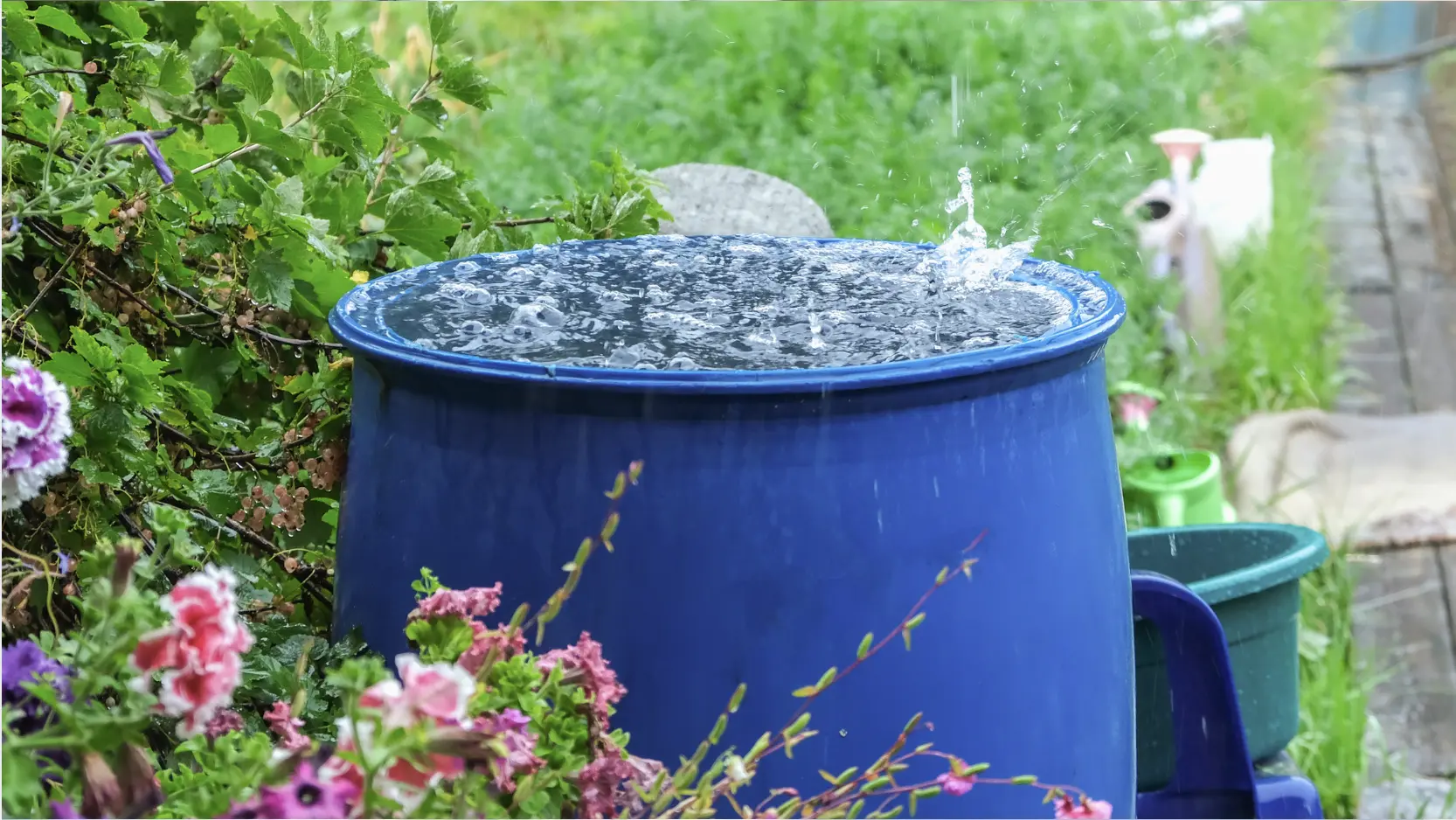
Rainwater harvesting is a passive, opportunistic system. It waits for a storm, catches whatever falls on your roof, filters it through screens and first-flush diverters, and stores it in a tank until you use it. When it rains, the tanks fill. When it doesn't, you're drawing down your stockpile.
An atmospheric water generator is an active, on-demand system. It pulls humid air through a chilled surface, condenses the water vapor, filters it, and delivers it to your plumbing as your household uses water. It does not care whether it rained last week.
That's the axis: opportunistic versus on-demand. Every other tradeoff (cost, quality, storage, reliability) traces back to that split.
How do rainwater collection and a Hydropack stack up side-by-side?
Here is the honest comparison, dimensions that matter most for anyone weighing the two.
Rainwater collection works by capturing precipitation off a roof and storing it in a tank — a system that, on a 2,000 sq ft roof in the Austin area, can yield roughly 33,000–35,000 gallons per year. The appeal is straightforward, but the limitations are real: output is seasonal, long dry stretches drain storage fast (central Texas can see 80–120 day dry intervals), and roof runoff can carry contaminants like lead, PFAS, E. coli, and coliforms without additional treatment. A complete system with gutters, tank, and water treatment typically runs $30,000–$75,000 upfront, with ongoing costs for filter changes, tank cleaning, UV lamp replacement, and pump electricity. It performs best in wet climates with large roofs and works well for non-potable uses like irrigation and livestock.
The Aquaria Hydropack takes a fundamentally different approach: it pulls moisture directly from ambient air, filters it through a sealed six-stage system tested by three independent labs, and delivers water on demand — no rainfall required. In rated conditions, a Hydropack S to Hydropack X can produce 20,000–39,000 gallons per year, with output tied to humidity and temperature rather than rain, making it far more consistent through dry stretches. Upfront cost runs $13,999–$34,999 (with financing from $137/mo), and ongoing costs are primarily electricity (roughly a quarter kilowatt-hour per gallon) plus an annual filter set of about $200–$400. The main constraint is humidity: the system is less effective below around 30% relative humidity, and it requires a power source — making it a strong fit for drought-prone areas and potable use, but not ideal for extremely arid, low-humidity environments.
In East Texas or the Gulf Coast, harvesting 55,000 gallons off a 2,000 square foot roof each year is theoretically possible though the storage tank requirements are far greater than a typical homeowner wants to have on their land. How much rainwater can you really collect off a roof?
The physics are simple, and the Texas Water Development Board publishes the formula. One inch of rain on one square foot of roof produces 0.62 gallons of water in theory. In practice, installers use a collection efficiency of 75 to 85 percent to account for first-flush diversion, gutter overshoot, evaporation, and splash loss.
Multiply it out for a 2,000 square foot roof:
- El Paso (10 in average annual rainfall): ~10,540 gallons per year at 85% efficiency.
- Midland (~14 in): ~14,750 gallons per year.
- San Antonio (~32 in): ~33,700 gallons per year.
- Houston (~50 in): ~52,700 gallons per year.
Stop and picture that El Paso number. Ten thousand gallons a year sounds like a lot right up until you divide it by 365. That comes out to 28 gallons a day, and it is not delivered that way. It arrives in a few bursts during a few thunderstorms, and the rest of the year the tank drains.
The TWDB's rainwater harvesting manual is direct about this: “In most Texas locations, rainfall occurs seasonally, requiring a large storage capacity to hold enough water collected during rain events to last through the dry spells.” Their sizing rule of thumb is a storage capacity that covers roughly quarterly demand, and in Central Texas they specifically recommend storage sufficient for about 80 consecutive days without rain.
That storage requirement is where the rainwater budget quietly explodes. A 20,000 gallon tank with potable-grade treatment (first-flush diverter, sediment filter, carbon block, UV disinfection, monitoring) can run $15,000 to $30,000 fully installed, before you even fill it. And in a bad drought year, the number of inches falling on the roof is not the number the TWDB averaged. It is often half of it.
What is actually in harvested rainwater?
This is the part homeowners often underestimate. Rainwater is clean in the sky. It picks up quite a bit on the way down and across a roof.
The University of Arizona's Project Harvest study, published in June 2026, tested roof-harvested rainwater across Arizona communities. The findings: lead and arsenic present at levels above what is considered safe for humans (even when within EPA enforceable limits), PFAS compounds including PFOA and PFOS at concentrations “greater than the EPA's most recent drinking water health advisories,” and total coliforms detected “more often at concentrations above” EPA standards. The report noted that “roof-harvested rainwater samples had greater PFOA, perfluorononanoic acid and perfluorobutane sulfonic acid mean concentrations than the control rainwater,” suggesting the contamination is tied to industrial activities depositing on the roof itself.
A 2019 global review published in npj Clean Water looked at roof-harvested rainwater tanks across dozens of studies. Across all of them, “the percentage of positive samples in rainwater tanks ranged from 24 to 92%, and therefore all studies had at least one tank that exceeded WHO health-related drinking water guidelines” for E. coli. The bacterial risks flagged in the literature include Salmonella, Campylobacter, Legionella, Cryptosporidium, and Giardia.
None of this makes rainwater unusable. It does mean that using harvested rainwater as drinking water requires a treatment train (first-flush diverter, sediment filter, carbon filter, UV disinfection at minimum) that you have to maintain and monitor. Skip a step and the risk shifts from theoretical to real. And PFAS specifically will not be removed by UV or a standard sediment/carbon setup; that requires reverse osmosis or specialty PFAS-adsorbing media added to the stack.
By comparison, an Aquaria Hydropack starts with distilled water from air condensation, then runs it through six filtration stages before it reaches your tap. In independent lab testing by Microbac Laboratories, Pace Analytical, and EMSL Analytical, the water showed non-detect or below-EPA-MCL results for over 100 substances, including PFAS. Test samples are not universal guarantees, but the source itself is fundamentally cleaner than roof runoff before treatment. Learn more about our water quality.
What does each system actually cost?
A basic rain barrel setup for irrigation is under $500. A potable-grade rainwater system built for full-time drinking-water use typically runs $30,000 to $75,000 installed, including the tank, treatment train, plumbing, and pump.
A Hydropack S runs $13,999 MSRP, or roughly $137 per month financed with $0 down. A Hydropack Standard is $22,499, or $207 per month. Installation adds $10,000 to $25,000 depending on trenching, storage tank, electrical, and delivery, and can be rolled into the financing.
Where the math tilts against rainwater is the storage penalty. A 20,000 gallon tank is not just an upfront line item. It is real estate on your property, permitting complexity, and a maintenance schedule that runs $300 to $1000+ a year. And you still have not solved the drought year problem. A tank sized for average years empties in a bad one.
The Hydropack's ongoing cost is more predictable: about a quarter kilowatt-hour of electricity per liter of water produced (24% to 60% more efficient than competitor AWGs), plus filter sets at $100 to $200 every four to six months. Not free, but not weather-dependent.
When rainwater collection is the better choice
We are not going to pretend Aquaria is always the answer. Rainwater harvesting genuinely wins for:
- High-rainfall climates. East Texas, Louisiana, the Pacific Northwest, most of the eastern half of the U.S. If you get 40+ inches of rain a year and have a decent roof, harvesting is cheaper per gallon than any other source.
- Non-potable use cases. Irrigation, livestock watering, toilet flushing, laundry. The treatment burden collapses and the economics look great.
- Large properties with big roof surfaces or barn structures. A 5,000+ square foot combined catchment area multiplies annual yield.
- Homeowners who want a passive system. No electricity, no moving parts on the collection side, no daily operating cost.
If any of those describes your situation, rainwater is likely the right call. Robert R., an Aquaria customer in McAllen, told us he still runs a rain barrel for his garden. He installed the Hydropack for drinking water because, as he put it, “the water tastes great, and I don't have to go to the store to buy it.” Different jobs, different tools.
When atmospheric water generation makes more sense
Where a Hydropack starts to look like the better call:
- Small roof footprint. Under 1,500 square feet cuts your rainwater yield roughly in half.
- Potable use as the primary need. Cooking, drinking, ice, coffee. The water quality gap between AWG and treated rainwater is real, and PFAS specifically is expensive to filter out of rainwater.
- Homeowners who already have solar. The Aquaria app coordinates production with solar output, effectively turning surplus daytime electricity into stored water.
- Drought insurance. A Hydropack does not know it is a drought year. Brian S. in the Hill Country told us he chose Aquaria over drilling a new well when his old one dried up: “I didn't want to put out $70,000 to drill a well when I could get into something like Aquaria.”
For homeowners across Texas, the monthly production data shows a Hydropack running near or above rated capacity from May through October, and roughly 40 to 60% of rated capacity in winter months. Combined with a storage tank sized to buffer the winter dip, the system produces water on a schedule you can plan around.
Rainwater and AWG as Complementary Systems
Rainwater collection is not competing with atmospheric water generation. They are two different answers to the same question of how you get water that doesn't come from a well or a utility.
Think of it less as wet climate versus dry climate and more as a storage problem. Rain falls in a season, and the size of the tank you're willing to install, not the total rainfall, is what actually limits how much of it you can bank. An urban dweller may only have enough space to store a few barrels of rainwater to cover simple needs like landscaping. But if you can size the tank big enough, then in most places rainwater alone can carry you through the dry months, though most people just don't want a tank that large on their property. An AWG has its own seasonal swing, since production rises and falls with humidity too, but because it's making water continuously instead of trying to catch a whole season's worth at once, it gets by on a much smaller tank.
This is where the two work well together, not just as a fallback for people stuck in the middle. Plenty of our customers harvest rain during the wet season and lean on a Hydropack the rest of the year, which gets them complete year-round coverage without needing an oversized tank to ride out every dry stretch. Rain barrels for irrigation and a Hydropack for the house is one common split; using both to cover the same household supply at different times of year is another. Together, these two systems support a resilient and self-reliant homestead.
What should you do next?
Every property is different: roof size, rainfall pattern, humidity range, existing well, storage constraints, solar setup. Book a call with an Aquaria Water Expert. We will tell you honestly whether a Hydropack is right for your situation, and we will tell you if it isn't, and point you toward a rainwater setup or a well solution instead.
If you want to see how the Hydropack lineup breaks down first, compare Hydropack models and specs.
Frequently Asked Questions
Is rainwater safe to drink without treatment?
No. Untreated rainwater consistently exceeds drinking water safety thresholds. The University of Arizona Project Harvest study detected lead, arsenic, PFAS compounds above EPA advisories, and total coliforms above EPA standards in roof-harvested rainwater. Making harvested rainwater potable requires a full treatment train: first-flush diverter, sediment filter, carbon filter, UV disinfection, and in most cases reverse osmosis for PFAS removal.
How much rainwater can I collect from my roof in Texas?
It depends on your rainfall and roof size. The formula from the Texas Water Development Board is: roof square footage × annual rainfall (inches) × 0.62 × 0.85 collection efficiency. For a 2,000 square foot roof, that works out to about 10,500 gallons a year in El Paso, 34,000 gallons in Austin, and 55,000+ gallons on the Gulf Coast.
Does an atmospheric water generator work in a dry climate?
Yes, with caveats. AWGs produce water most efficiently between about 40% and 80% relative humidity. In the driest desert conditions (below 30% RH), production drops sharply. In most of Texas, including Hill Country and the Rio Grande Valley, humidity stays high enough year-round for a Hydropack to run near rated capacity, with a seasonal dip in winter months that a properly sized storage tank buffers.
Which is cheaper, a rainwater system or an atmospheric water generator?
For a whole-home potable system, an AWG is financially a better option. A rainwater setup with a 20,000-gallon tank and full potable treatment train typically runs $30,000 to $75,000 installed. A Hydropack S is $13,999, or roughly $137 a month financed. The bigger difference is not upfront cost but reliability: the rainwater system is dependent on annual rainfall; the AWG produces on a predictable schedule.
Can I run both a rainwater system and an AWG?
Yes, and many of our customers do. A hybrid setup uses rainwater for irrigation, livestock, and non-potable uses, and the Hydropack for drinking, cooking, and household potable water. The rainwater side stays low-treatment and cheap, and the AWG handles the water quality-sensitive uses. It is often the most cost-effective path to real water independence. It also solves a timing problem: rain shows up in a season, and the AWG fills in the rest of the year, so you get complete coverage without sizing a tank for the whole year's worth of water.
Subscribe to our Newsletter
Get the latest updates, news and insights directly to your inbox
No payments for 6 months. Get your Hydropixel delivered free in the continental US.
Get Your Free Water Plan
Two quick steps. We'll send the right system size, expected output for your climate, and exact pricing — usually within one business day.