
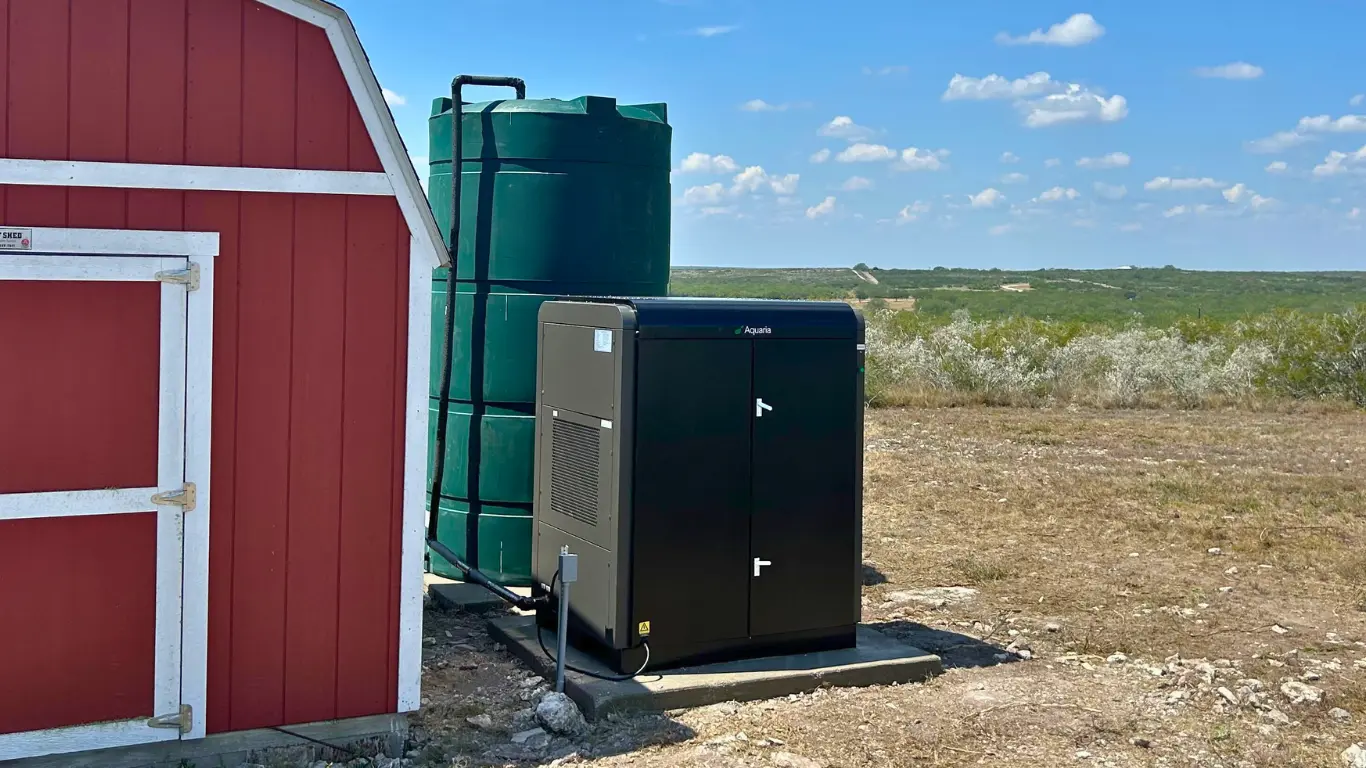
TL;DR: Choose an atmospheric water generator (AWG) by matching seven things to your situation: daily output, energy efficiency (Wh/L), climate fit, certified water quality, plumbing integration, software intelligence, and total cost over the system's life. The best AWG for you isn't the one with the flashiest spec sheet, it's the one that produces the gallons you actually need, in your actual climate, at a per-gallon cost that competes with your real alternative.
If you've started looking at atmospheric water generators, you've probably noticed the category is messy. Some products are countertop dispensers that produce a few gallons a day. Others are whole-home systems that tie into your plumbing. Prices range from a few hundred dollars to tens of thousands. Specs are published in different units. Some manufacturers share lab results. Most don't. And every product page calls itself "the best."
This guide is built to cut through that. By the end, you'll have a clear framework for evaluating any AWG against your actual situation, a backup water source for a 3-bedroom home in Texas, the primary supply for an off-grid property, or an added layer of resilience on top of a working well. We'll also be straight about where Aquaria's Hydropack fits that framework — and where it doesn't.
Why does choosing an AWG need a framework, not a top-10 list?
Most "best atmospheric water generator (AWG)" articles compare two countertop products on price and call it done. That's not useful if you're trying to decide whether AWG can replace or supplement a well, integrate with your plumbing, or pair with your solar system.
A buyer's framework helps because the AWG category spans four different use cases that look identical on a search page:
- Drinking water only: countertop or under-counter units producing 2–8 gallons per day
- Whole-home water: units producing 60–260+ gallons per day, plumbed into the house, replacing or supplementing a well or municipal supply
- Off-grid primary supply: high-output systems sized to a property's full daily demand, often paired with solar and storage
- Commercial / community-scale: systems producing thousands of gallons per day for facilities, schools, or villages
A unit that's well-suited to one use case can be the wrong purchase for another. The seven criteria below shift the question from "is this AWG good?" to the more useful one: "is this AWG good for what I'm trying to do?"
And the stakes are concrete. The U.S. Geological Survey reported in July 2023 that "At least 45% of the nation's tap water has one or more types of forever chemicals". The American Society of Civil Engineers gave U.S. drinking water infrastructure a C- grade in its 2025 "Report Card for America's Infrastructure". And as of April 2026, the National Drought Mitigation Center's "U.S. Drought Monitor" showed nearly 30% of the country in some level of drought.
Homeowners are looking at atmospheric water generators for real reasons. Picking the right one is worth doing carefully.
What is an atmospheric water generator, briefly?
An atmospheric water generator pulls water vapor out of the air and condenses it into clean liquid water. Most consumer AWGs use a refrigeration cycle, the same physics as a dehumidifier or a window air conditioner, then run that condensate through a filtration and mineralization stack to make it drinkable. (For the longer explanation, see our What are Atmospheric Water Generators and How Do They Work.)
What matters for the buying decision is that AWG performance is governed by physics: humidity, temperature, energy input, and condenser surface area. Those four variables determine how much water any AWG can produce, how efficiently, and in what climates. The rest of this article is, essentially, a way to read a spec sheet through that physics lens.
What are the 7 criteria for choosing an atmospheric water generator?
1. Daily output: match it to your real water demand, not a marketing number
Start by figuring out how much water you actually need. The U.S. Environmental Protection Agency estimates the average American uses roughly 82 gallons of water per day at home, though indoor potable use (drinking, cooking, dishes, showers, laundry) is typically the portion an AWG would replace, and that varies widely by household.
A practical way to size:
- Drinking + cooking only: 1-3 gallons per person per day
- All indoor use, small household: 30-60 gallons per day
- Whole-home replacement, family of 4: 120-250 gallons per day
- Whole-home + landscape, large property: 300+ gallons per day
Then look at how AWG output is reported. Most manufacturers publish a "rated maximum" output, the number a unit hits in ideal conditions (typically 80°F, 80% relative humidity, in a lab). That number is real, but you won't see it every day. Ask two follow-up questions:
- What's the rated capacity? This sets the ceiling.
- What's the production curve at lower humidity? A unit rated at 100 gallons/day at 80% RH might produce 30 gallons/day at 50% RH and effectively zero below 30% RH.
For context, Aquaria's Hydropack is rated up to 132 gallons per day, with a smaller Hydropack S model rated at 66 gallons per day. Production scales above and below that based on conditions, and can exceed rated capacity in unusually high humidity. Countertop AWGs from competing brands typically rate between 2 and 8 gallons per day.
The right output number is the one that exceeds your real demand on average days in your climate, with a margin for hot/dry stretches when production drops.
2. Energy efficiency (Wh/L): the spec most buyers ignore
Energy use per liter of water (Wh/L, or sometimes kWh per gallon) is the spec that determines what your AWG actually costs to run. It's also the spec that varies most widely across the category, and it's often buried or omitted entirely in marketing materials.
Why it matters: a unit that produces 100 gallons/day at 800 Wh/L uses roughly four times more electricity than one that produces 100 gallons/day at 200 Wh/L. Over a 10-year ownership window, that's a five-figure difference in operating cost.
How much energy does it take to pull water from air?
The Hydropack does it on under 240 Wh per liter — for a sense of scale, that's about the energy it takes to run a microwave for 15 minutes. Most other atmospheric water generators need 350–800 Wh to make the same liter, meaning the Hydropack uses 24% to 60%+ less energy per gallon produced. Our lab prototype goes lower still, under 190 Wh/L.
Three engineering choices get us there:
1. We reuse the heat the system makes. Pulling water from air gives off heat. Most AWGs vent it. We capture it and use it to condense more water — at no extra energy cost.
2. The surface that forms water moves heat 14× better than copper. The condenser uses a metal-graphene alloy with very high thermal conductivity (5,700 W/mK). Heat moves out faster, water forms faster, and the system spends less energy waiting.
3. The airflow is shaped to do more with less. Water-shedding (hydrophobic) coatings plus cyclone-style airflow mean more humid air passes through the system, and the water that forms drains off cleanly instead of clogging the surface.
Lower energy per liter matters most when the Hydropack runs off solar, or in a home where every watt is accounted for.
3. Climate fit: humidity, temperature, and your specific location
An AWG's spec sheet is meaningless if it doesn't match your climate. Two locations on the same latitude can have wildly different AWG production profiles depending on humidity patterns, and any honest buyer's framework has to account for that.
The rough rules:
- Above 60% average relative humidity: AWGs perform near rated capacity for most of the year. Coastal Southeast, Gulf Coast, much of the Pacific Northwest.
- 40-60% RH: Solid year-round production with some seasonal dips. Most of the inland Eastern U.S., parts of the Midwest, much of California's coastal corridor.
- 30-40% RH: Workable with proper sizing and storage strategy. Parts of the Southwest in shoulder seasons.
- Below 30% RH: AWG production approaches zero. Truly arid environments (interior desert Southwest in summer) need a different solution, or AWG sized only for monsoon and shoulder-season production paired with significant storage.
Don't trust generic "works in any climate" claims. Ask for:
- A production-vs-humidity curve specific to the model
- Monthly production estimates for cities near you
- Storage tank recommendations for your climate
The short version: a competent AWG manufacturer will give you a city-specific production estimate, not a global average. If they can't, treat the rated number as aspirational.
4. Water quality: independent lab testing and what it actually shows
Water from an AWG is only as good as its filtration stack and the testing behind it. Two questions cut to the answer fast:
Has the water been tested by a named, third-party lab?
"Tested" without a lab name is meaningless. Look for results from accredited labs like Microbac Laboratories, Pace Analytical, or EMSL Analytical, with the specific analytes tested and the results published.
What does the result actually say?
AWG water naturally tends to be very low in minerals (it's distilled-equivalent at production), then mineralized back to a balanced TDS through the filtration stack. The results that matter:
- Heavy metals (lead, arsenic, mercury): should be non-detect
- PFAS (per- and polyfluoroalkyl substances): should be non-detect
- VOCs (volatile organic compounds from the air): should be non-detect or below EPA maximum contaminant levels
- Microbiological (bacteria, viruses): should be non-detect
- TDS (total dissolved solids): should be in a balanced, palatable range after mineralization
Aquaria's Hydropack water has been independently tested by SimpleLab, an ISO-accredited laboratory. Across 100+ substances, results came back non-detect or below EPA maximum contaminant levels and WHO guideline values in the samples tested.
5. Integration: drinking water vs. whole-home plumbing
This is the single biggest distinction within the AWG category and the one most product pages obscure.
Personal/drinking units sit on a counter or under a sink, produce a few gallons a day, and are dispensed manually or through a single tap. They don't connect to your home plumbing, don't supply your shower, dishwasher, or washing machine, and won't help if your municipal supply is disrupted for everyday uses beyond drinking.
Whole-home units are sized for household demand, plumb directly into your existing pipes (typically through a storage tank and pressure system), and supply every fixture in the house. They function as a primary or backup water source, not a drinking water appliance.
Which type makes sense depends on your goal. If you're solving for "I want cleaner drinking water than my tap provides," a personal unit or a quality reverse-osmosis filter might be a better fit, and you should compare it to alternatives. If you're solving for "I want a water source that doesn't depend on a well or a municipal pipe," only a whole-home AWG belongs in your shortlist.
Ask for the installation diagram. Ask whether the unit ships with a storage tank or requires you to source one separately. Ask what plumbing connections, electrical service, and pad/footing requirements it has. A whole-home AWG is infrastructure, and the install matters as much as the box.
6. Software and smart controls: not gimmicks, real efficiency gains
Most AWGs are dumb appliances: they run when you tell them to. The next generation, including the Hydropack, includes software that meaningfully changes the economics.
What to look for:
- Smart scheduling: production aligned to peak humidity windows in your area, capturing more water per kilowatt-hour
- Solar alignment: production scheduled to coincide with rooftop solar generation, slashing operating cost for solar-equipped homes
- Remote monitoring: current production, water quality, system status, and fault alerts visible from a phone
- Climate-adaptive optimization: automatic adjustment to current humidity and temperature conditions
The Hydropack runs through the Aquaria app, which handles all four. For a Texas homeowner with rooftop solar, this can mean producing the day's water during peak solar hours at near-zero marginal energy cost, the same logic that made Tesla's Powerwall a category-defining product on the electricity side. (For more on the solar side, see How Solar Owners Can Become Water and Energy Independent.)
Software is not the most important criterion, but it's the easiest one to overlook and one of the few that compounds in your favor over the system's life.
7. Total cost of ownership: upfront, operating, and replacement
Don't buy on sticker price alone. Total cost of ownership over 10-15 years is what actually matters, and three numbers drive it:
- Upfront cost: equipment + installation + storage tank + plumbing/electrical work
- Operating cost: annual electricity at your local rate, multiplied by the unit's Wh/L and your daily output
- Maintenance and consumables: filter replacements (typically annual), service intervals, warranty coverage
A few framing points:
- A whole-home AWG is closer in total cost to drilling a new well ($40,000-$100,000+ depending on geology, with no guarantee of hitting water) than to a countertop water filter. We covered this in Is Drilling a Well Worth It? 2026 Cost & Predictability Guide.
- A bottled-water household commonly spends $1,200-$2,400/year. Over 10 years that's $12,000-$24,000 with no asset at the end.
- Financing is real. Aquaria's Hydropack starts at approximately $137/month with consumer financing of up to 20 years, which reframes the upfront question into a monthly one comparable to a utility bill or a solar loan.
- Warranty matters. The Hydropack carries a 3-year warranty; ask any competing manufacturer for the equivalent and read it carefully.
The right way to compare: build a 10-year cost model for each AWG candidate, including your alternative (well, RO + bottled, status quo). The right answer is usually clearer than the spec sheet alone makes it look.
How do you apply the framework to a real buying decision?
For most homeowners evaluating AWG seriously, the framework collapses to a simple sequence:
- Decide the use case (drinking only vs. whole-home vs. off-grid primary). Most readers ruling out countertop units belongs here.
- Set a daily output target based on real household demand plus a margin.
- Ask each candidate for: rated output, Wh/L, production curve at your local average humidity, full lab reports with lab names, installation requirements, software capabilities, and 10-year total cost.
- Cross-check against your real alternative (well, municipal + RO, bottled water, status quo).
- Verify warranty and service coverage in your area before committing.
Aquaria's Hydropack was engineered for criteria 1-7 in this order: whole-home output (66 or 132 gal/day), category-leading efficiency (under 240 Wh/L), broad climate operability with the Aquaria app to optimize production, water tested by three independent labs, direct plumbing integration, software-driven scheduling, and financing that compares cleanly to a well or bottled-water budget. It is not the right answer for someone who only needs 2 gallons a day at a kitchen counter, and it's the wrong answer for someone in a sub-30% RH environment without a storage and scheduling strategy. Both of those facts are part of the framework working, not against it.
Ready to see if a Hydropack fits your situation? Compare Hydropack models and specs to see which configuration matches your output target and climate, then take the next step from there.
Frequently asked questions
What's the most important spec when choosing an atmospheric water generator?
Daily output paired with energy efficiency (Wh/L), in that order. Output tells you whether the unit can meet your demand; Wh/L tells you what running it will cost over the system's life. The two together determine whether an AWG is the right tool for your situation.
Can an atmospheric water generator replace a well?
Yes, in most non-arid U.S. climates a properly sized whole-home AWG can replace a well as a primary water source, particularly when paired with adequate storage. In low-humidity environments below about 30% average relative humidity, AWG works better as a supplement than a primary supply. We covered the comparison in Is Drilling a Well Worth It?.
How much electricity does an atmospheric water generator use?
It depends entirely on the unit's efficiency. An AWG operating at under 240 Wh/L producing 100 gallons (about 379 liters) per day uses roughly 91 kWh/day at peak production. A less efficient unit at 600 Wh/L producing the same volume uses about 227 kWh/day. Always ask for the Wh/L number and use it to model annual electricity cost at your local utility rate.
Is water from an atmospheric water generator safe to drink?
Yes, when the unit's water has been independently tested by accredited labs and the results show non-detect for contaminants. In testing by Microbac Laboratories, Pace Analytical, and EMSL Analytical, Aquaria's Hydropack water samples were non-detect or below EPA maximum contaminant levels for 100+ substances. Always require lab names and dated reports from any AWG manufacturer before treating their water as potable.
Do atmospheric water generators work in dry climates?
Yes, in most climates: above about 40% average relative humidity, a quality AWG produces meaningful water year-round. Between 30% and 40% RH, AWG works with proper sizing and storage. Below 30% RH, production approaches zero and AWG is generally not the right primary water solution.
How much does a whole-home atmospheric water generator cost?
Whole-home AWG systems vary widely. The Hydropack starts at approximately $137/month with consumer financing of up to 20 years, with upfront pricing varying by configuration and installation requirements. For comparison, drilling a new well in much of the U.S. costs $40,000-$100,000 with no guarantee of hitting water, and a household reliant on bottled water typically spends $1,200-$2,400 per year. Build a 10-year total cost of ownership model for the AWGs on your shortlist and compare it directly to your real alternative.
Subscribe to our Newsletter
Get the latest updates, news and insights directly to your inbox
No payments for 6 months on any Hydropack. Get your Hydropixel delivered free in the continental US.
Get Your Free Water Plan
Two quick steps. We'll send the right system size, expected output for your climate, and exact pricing — usually within one business day.