
.png)
TL;DR: An atmospheric water generator (AWG) is a machine that makes clean drinking water from the humidity in the air. It pulls in air, cools it past its dew point so the water vapor condenses into liquid, then filters that water for use. Home units range from a gallon a day up to 264 gallons a day — enough to supply a whole house — with no well, no municipal line, and no pipes in from outside.
There are roughly 13,000 cubic kilometers of water suspended in the air at any moment — about six to seven times the water in all the world's rivers combined. An atmospheric water generator turns that invisible, constantly renewing supply into water you can drink. The technology has existed for decades, but only recently has it become efficient and affordable enough to run a home.
This guide explains what an AWG is, how it works, the two main types, how much water it produces, and whether the water is safe to drink.
What is an atmospheric water generator?
An atmospheric water generator, also called a water-from-air generator, an air-to-water machine, or an atmospheric water collector, is an appliance that extracts water vapor from the surrounding air and converts it into clean, potable water. It doesn't draw from a well, a reservoir, or a municipal pipe. Its only inputs are air, electricity, and humidity.
The amount of water it can make depends mostly on humidity and temperature: the more moisture in the air, the more water it can pull out. That's why an AWG is best understood as an on-site water source that works with your local climate, sized with storage to cover drier stretches.
How does an atmospheric water generator work?
Most home and whole-home AWGs work by condensation, using the same basic refrigerant cycle as an air conditioner. The process has four steps:
- Air intake. A fan draws ambient air into the system and passes it over a cold evaporator coil.
- Condensation. The coil cools the air below its dew point (the temperature at which water vapor changes from gas to liquid) so moisture condenses onto the coil and drips into a collection tank.
- Filtration. The collected water passes through multi-stage filtration and UV treatment to remove particulates, organics, and microbes before it's stored.
- Storage and delivery. Clean water is held in a tank and delivered to a tap or, in whole-home systems, into the home's plumbing.
Because more than 75% of an AWG's energy goes to running the refrigerant compressor, efficiency comes down to two things: condensing more water per unit of air, and using less energy per cycle. The Aquaria Hydropack, for example, produces water at under 240 watt-hours per liter, where many units need 350–800.
What are the two main types of atmospheric water generator?
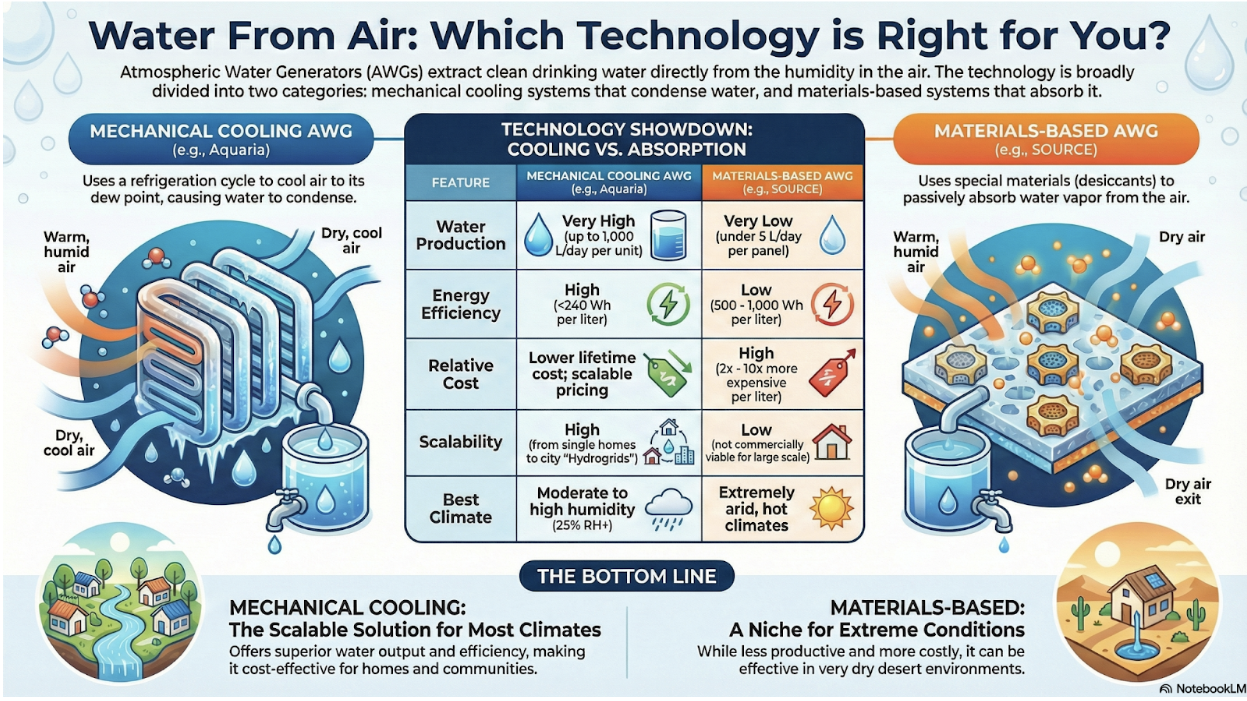
AWG technology falls into two categories: mechanical (cooling) systems and materials-based (desiccant) systems. They solve the same problem in very different ways.
Mechanical cooling is the market leader for home and whole-home use because it produces far more water per unit of size and energy in most climates. Desiccant systems are promising for very dry regions, where there isn't enough humidity for cooling to condense water efficiently, but their low yield and high material costs keep most of them out of everyday home use for now.
You may also see AWGs described as dew condensers, split into "passive" units that rely on natural temperature differences (small output, no filtration) and "active" units, the standard powered AWG, that use a refrigeration system and include filtration. Home active units range from about 1 to 20 liters a day at the small end up to 264 gallons a day for whole-home models, while commercial systems reach 1,000 to 10,000+ liters a day. (Sources: WE Forum, Ahrestani et al)
How much water can an atmospheric water generator produce?
Output ranges enormously by size and climate. Countertop drinking units make roughly 1–8 gallons (4–30 liters) a day; whole-home systems make 60–264 gallons a day; commercial and industrial units reach thousands of liters. Every figure is a rated maximum under favorable humidity and temperature, real output is lower in dry air, which is why sizing to your local climate, with a storage tank for reserve, matters more than the headline number on the box.
Is water from air safe to drink?
Yes, once it's filtered. Powered AWGs like Aquaria's pass every drop through multi-stage filtration and UV treatment before storage. Aquaria's Hydropack water has been independently tested by accredited third-party labs, with results across 100+ substances coming back non-detect or below EPA maximum contaminant levels in the samples tested, including no detected microplastics, PFAS, or dissolved heavy metals.
Water from air is also clean by nature before it's ever filtered. As surface water evaporates, it leaves heavier molecules behind, so atmospheric humidity starts out purer than groundwater. It's even cleaner than rainwater, because rain picks up particles and gases during cloud formation and the fall to the ground, while air-water is captured and filtered before that happens.
Where are atmospheric water generators used?
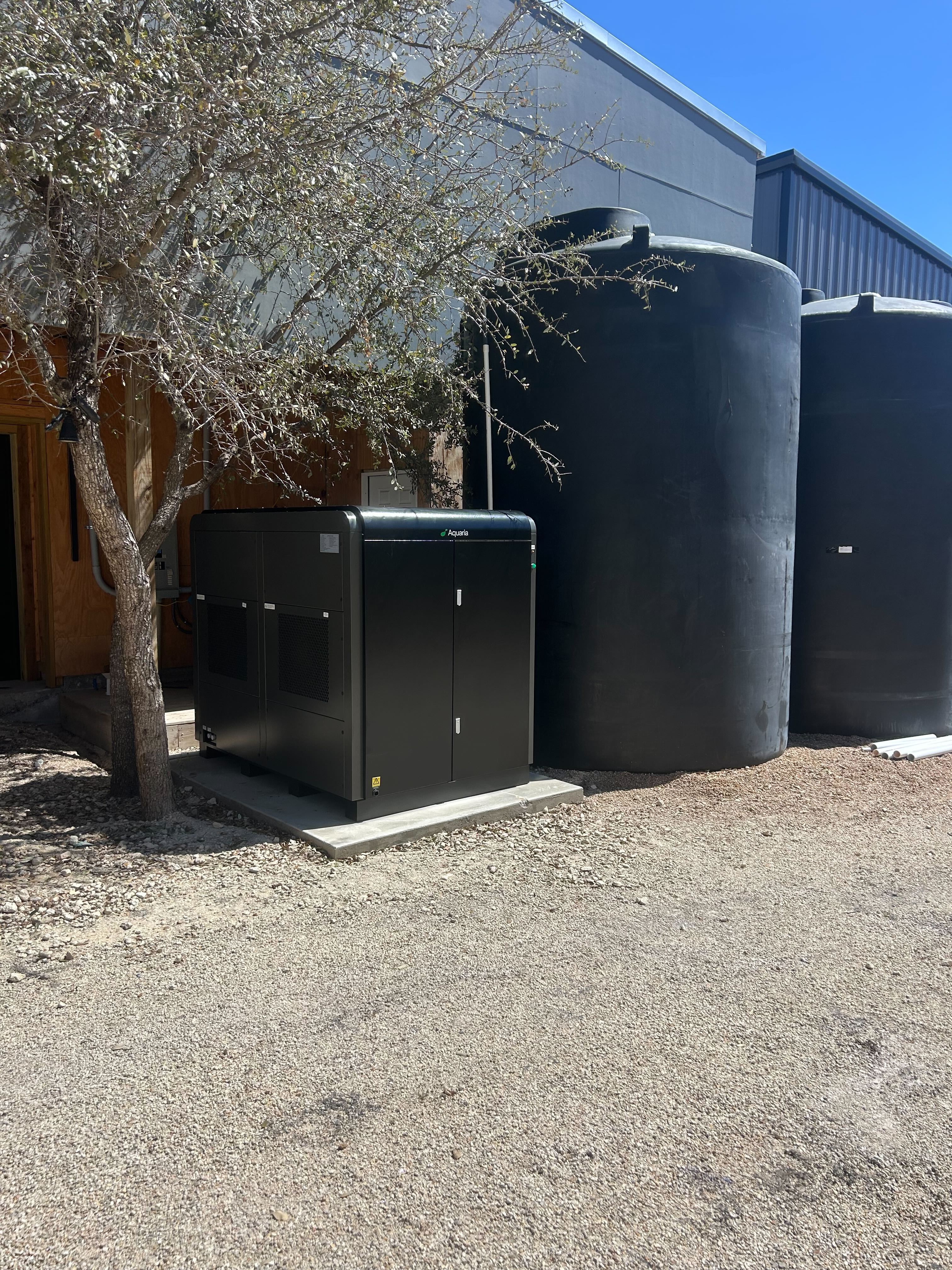
AWGs scale from a single tap to entire developments. Common applications include residential drinking water and whole-home supply; commercial water for offices, hotels, and factories; real-estate development, where an on-site water source can unlock land with no existing water infrastructure; and relief and emergency response, where water is needed on demand after a disaster.
The takeaway
An atmospheric water generator is, at its simplest, a way to make your own water from the air around you — reliably, cleanly, and independent of wells or municipal supply. The science is settled and the technology is proven; the real question for any home is matching the right system and storage to your climate and your daily water needs.
See how the Hydropack makes water from air →
Frequently Asked Questions
How does an atmospheric water generator work?
It draws in air, cools it below its dew point so the water vapor condenses into liquid, then filters and stores that water. Most home and whole-home units use a refrigerant cooling cycle, the same basic principle as an air conditioner, paired with multi-stage filtration.
Is water from an atmospheric water generator safe to drink?
Yes, once filtered. Powered AWGs include multi-stage filtration and UV treatment. Aquaria's Hydropack water has been independently lab-tested, with results non-detect or below EPA limits across 100+ substances in the samples tested. Passive dew condensers without filtration are the exception and shouldn't be treated as potable. Further, water made from air is naturally cleaner than groundwater or rainwater. As surface water evaporates, it leaves behind heavier molecules as it becomes atmospheric humidity. Compared to rainwater, air-water is also cleaner by nature. Rainwater already contains contaminants in the sky because both cloud formation and the raindrop’s fall involve contact with particles and gases in the atmosphere, not just with surfaces on the ground.(source: National Institute of Health)
How much water can an atmospheric water generator make per day?
It depends on the model and your climate. Countertop units make roughly 1–8 gallons (4–30 liters) a day; whole-home systems make 60–264 gallons a day; commercial units reach thousands of liters. Output drops in dry air, so size for your local humidity with storage.
What is the difference between a mechanical and a desiccant AWG?
Mechanical AWGs cool air below its dew point with a refrigerant cycle and produce high volumes in humid and moderate climates. Desiccant AWGs absorb moisture with materials like silica gel or MOFs and work better in very dry air, but produce less water and cost more per unit of output.
Does an atmospheric water generator work in dry climates?
It can, but output falls as humidity drops. Mechanical systems are most efficient in humid and moderate conditions; very arid regions may favor desiccant systems or require careful sizing and storage. Ask any manufacturer for a production curve at your local average humidity, not just the lab-ideal maximum.
Is an atmospheric water generator the same as a dehumidifier?
No. Both condense moisture from air, but a dehumidifier is built to dry a room and its water isn't treated for drinking. An AWG is engineered to produce potable water, with filtration and UV treatment that a dehumidifier doesn't have.
Subscribe to our Newsletter
Get the latest updates, news and insights directly to your inbox
No payments for 6 months. Get your Hydropixel delivered free in the continental US.
Get Your Free Water Plan
Two quick steps. We'll send the right system size, expected output for your climate, and exact pricing — usually within one business day.