
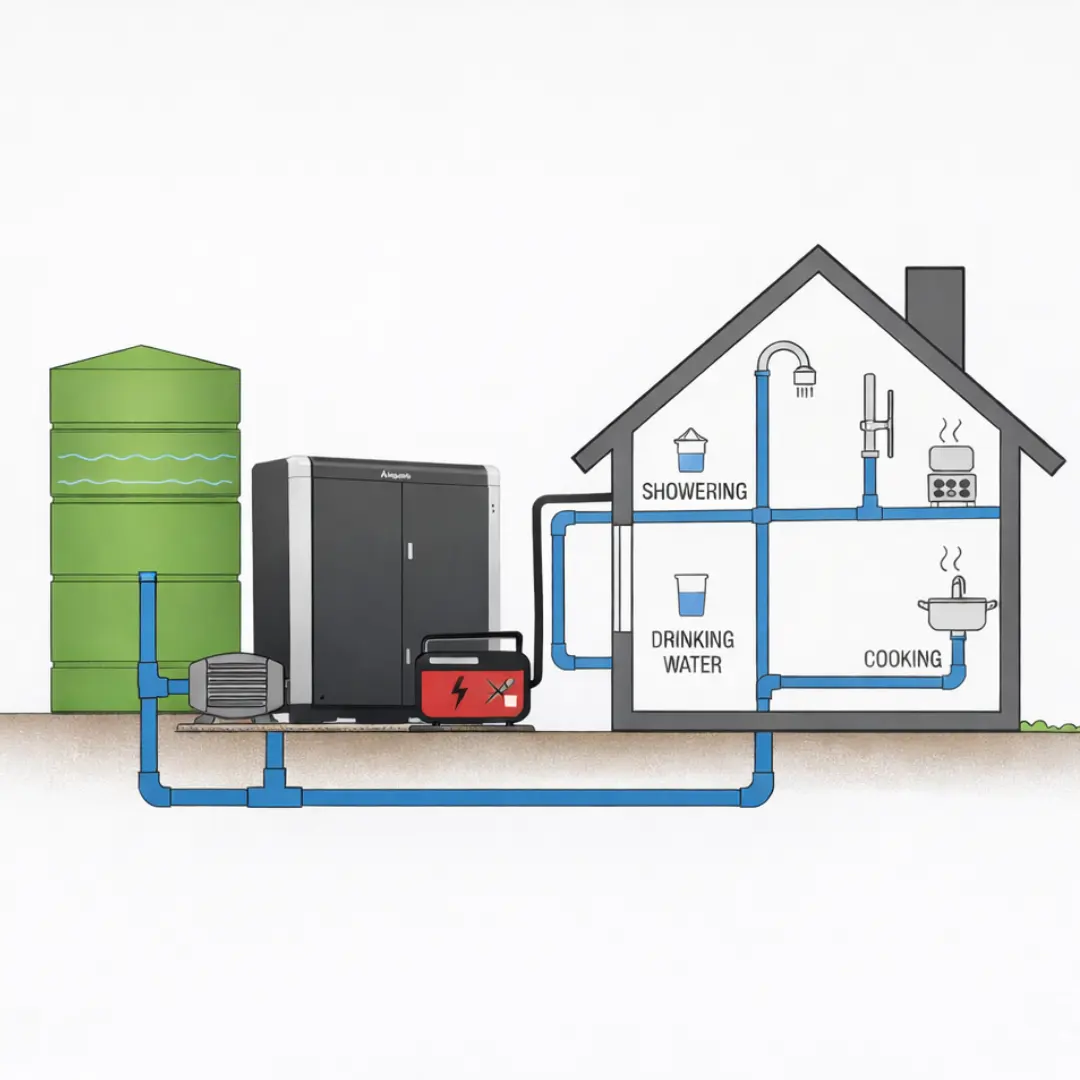
TL;DR: Owning a home atmospheric water generator (AWG) feels much less dramatic than the technology sounds. After install, the system sits outside, makes water on a quiet schedule, fills a storage tank, and feeds your plumbing; the daily ask is a weekly walk-around, filter changes once or twice a year, and an annual professional check.
Most of the questions we get about home atmospheric water generators aren’t about specs. They’re about what life with one feels like. Is it loud? Does it run all the time? What if humidity drops? How often do I have to think about it?
We’ve spent the last few years walking homeowners through every step of that, from the first site survey to year three of ownership. Here’s the honest picture, including the parts that work the way people expect and the parts that surprise them.
Why do people start asking about atmospheric water generators in the first place?
Almost no one buys a home AWG because the technology is interesting. People buy because something about their existing water situation stopped feeling stable.
In every conversation we have, it’s one of four things:
- A well that’s getting slower, or a neighbor’s well that already ran dry
- A boil-water notice or a contamination alert that landed in their inbox
- A new data center, factory, or housing development going in upstream
- A growing list of items they don’t want in their water, most commonly PFAS
These aren’t abstract worries. According to the U.S. Geological Survey’s 2023 national PFAS study, at least 45% of U.S. tap water contains one or more PFAS “forever chemicals” (USGS, July 2023). The American Society of Civil Engineers’ 2025 Report Card for America’s Infrastructure gives U.S. drinking water a C-, with more than a trillion dollars in needed investment over the coming decades (ASCE, March 2025).
Stop and picture that. A C- grade isn’t a rumor. It’s the engineering profession saying out loud that the system delivering water to your tap is, on average, just barely passing. That’s the backdrop. Owning an AWG isn’t about replacing that system. It’s about not being entirely dependent on it.
For a deeper look at why homeowners are increasingly turning to atmospheric water as a category, see our overview of the first whole-home AWG.
How does home AWG ownership compare to the alternatives?
Before getting into what daily life looks like, it’s worth being honest about the trade-offs. People considering a home atmospheric water generator are usually weighing it against other ways to handle water reliability and quality. Here’s how they actually stack up:
A few things to call out from that table.
When city water is the better choice. If your municipal supply is reliable, clean, and not under sustained drought or contamination stress, you don’t need an AWG. You might want one for resilience, but you don’t need one to solve a current problem. There’s no shame in that being the right answer.
When a well is the better choice. If you’re on rural land with proven groundwater, no contamination history, and an affordable drilling environment, a well is often the cheaper long-term option. AWG makes more sense when wells are expensive, slow, depleting, or risky, which is increasingly the case in Texas, parts of California, and other water-stressed states. For a deeper look at that trade-off, see our breakdown of AWG vs. well water for your home.
When AWG is the better choice. When you want the source of your water, not just the filter on it, to be under your own roof. That’s the distinct thing an atmospheric water generator does that none of the other options do.
Compare Hydropack models and what fits your home →
What does the install actually involve?
Buying a home AWG is closer to installing a heat pump than buying an appliance. There’s a site survey, a permit conversation, a contractor, and a half-day to a day of work.
Aquaria (aquaria.world), the U.S.-based atmospheric water generation company headquartered in Austin, Texas, builds its Hydropack systems to be installed outdoors, typically in a back or side yard with at least 3.3 feet of clearance on every side. The work usually involves:
- Pouring or placing a concrete pad
- Tying into the electrical panel (a dedicated circuit)
- Plumbing the unit to a storage tank (commonly 300 to 500 gallons, sized to 2 to 3 days of production)
- Plumbing the tank into the home with an external pump and valves
The Hydropack is supported up to about 35 to 40 feet horizontally and 15 to 20 feet vertically, which covers almost every residential layout. Hydropack S is sized for smaller homes (~66 gallons/day), Hydropack for typical households (~132 gallons/day), and Hydropack X for high-demand homes and ADUs (~264 gallons/day). For help choosing between them, see our buyer’s framework for atmospheric water generators.
Brian S. in Hill Country went this route after looking at the alternative. In his own words: “I didn’t want to put out $70,000 to drill a well when I could get into something like [the Hydropack].”
That math, a financed home AWG versus a six-figure well bet, is the conversation most Texas homeowners we talk to are actually having.
What does daily life with a home AWG feel like?
Here’s the part people are usually most curious about and most surprised by: there isn’t much.
Once the system is installed and commissioned, day-to-day ownership of a Hydropack should feel quiet, unobtrusive, and consistent. No daily routine, no dashboards to babysit, no buttons to push. The unit runs when conditions are favorable, typically the warm, humid parts of the day, and rests when they’re not. The storage tank smooths out the difference between when water is made and when you use it.
What you hear. Operation is closer to a heat pump than a generator. There’s an audible hum at close range; from inside the house, with the unit on a pad in the yard, most homeowners report not noticing it at all. Anything louder than that, or a harsh mechanical noise, isn’t normal and should be addressed.
What you see. The system itself, sitting where the contractor placed it. The tank, either above-ground next to it or buried, depending on your install. If you’ve integrated with the Aquaria app, you’ll see daily production, tank level, energy use, and weather-aware production windows on your phone, but most owners check it once a week, if that.
What you do. Walk around the unit once a week. Clear leaves, grass clippings, and debris. Check that nothing has been stored against it and that the 3.3-foot clearance is intact. After storms or high winds, do it again. That’s the weekly commitment.
How you use the water. Most Hydropack households use the system for everything water-related: drinking, cooking, showers, laundry. Some keep municipal or well water online for high-volume outdoor uses (irrigation, pools) and run the Hydropack water everywhere it actually matters. Both patterns work.
The bigger change isn’t physical. It’s that you stop thinking about your water. Boil notices, rate hikes, drought stage announcements still happen in your area, but they stop being your problem in the same way.
How much maintenance does a home AWG really need?
Maintenance on a home atmospheric water generator is light by appliance standards. The full annual commitment is:
- Weekly: 5-minute walk-around. Clear debris, check clearance. After storms, repeat.
- Once or twice a year: Filter set replacement. Water filters and air filters are sold as a single set; cost runs roughly $100 to $400 depending on model. Twice a year is recommended for daily, full-home use; once a year is typical for supplementary use.
- Annually: A professional service (“deep clean”). This is the equivalent of an HVAC tune-up. A technician inspects the system, services components, and confirms everything is running within spec.
- Annually: A water quality test, taken from the tap that serves your household (post-tank), ideally after winterization or filter changes. Testing coordination is the homeowner’s responsibility. This is how you verify that what you’re drinking is what the system promised.
For water quality, every Hydropack’s output is built on the same underlying claim: in independent lab testing by Microbac Laboratories, Pace Analytical, and EMSL Analytical, Aquaria’s water tested non-detect values for 100+ substances. That’s what the annual home test is verifying for your specific installation.
For a deeper look at the lifetime cost picture, see our TCO breakdown of atmospheric water generator cost.
What surprises new owners?
A few honest patterns from the first few years of Hydropack ownership, in both directions.
The pleasant surprises.
- The water tastes noticeably good. As Robert R. in McAllen put it: “The water tastes great, and I don’t have to go to the store to buy it.” No chlorine taste, no mineral aftertaste, and for owners coming off bottled water, no plastic.
- The system is more “set it and forget it” than expected. Most owners describe it after the first few months as more like a water heater than a piece of new tech.
- The Aquaria app integration is more useful than expected, especially for solar homeowners. The system can be scheduled to produce water when solar generation is at peak, what David & Gladys Scales in San Antonio described as the moment they realized “we have the potential to be energy and water self-sufficient.”
The honest surprises.
- Climate matters. In dry, cold months, production drops. This is why we recommend tank sizing of 2 to 3 days of production minimum: the tank is what carries you through the gaps. Homeowners in low-humidity climates need to plan for this; it’s not a flaw, it’s physics.
- Power matters. Hydropack runs on grid or solar power. Most home installs draw under 240 Wh per liter of water produced, efficient by industry standards (competitors typically run 350 to 800 Wh/L), but still a real electricity line item. Solar pairing changes that math.
- The install isn’t trivial. This isn’t an appliance you plug in. It’s infrastructure, with permits, contractor work, and a few days of disruption. Worth knowing going in.
The right next step
If you’re trying to decide whether a home atmospheric water generator fits your situation, the honest answer is: it depends on your climate, your current water source, your roof and yard, your electrical setup, and what failure mode you’re actually trying to insure against.
The right next step isn’t a purchase. It’s a conversation. Book a call with an Aquaria Water Expert. We’ll walk through your property and your water situation and tell you honestly whether atmospheric water generation makes sense for your home. We’ll also tell you if it doesn’t.
Frequently Asked Questions
Is a home atmospheric water generator loud?
No. A Hydropack installed outdoors on a proper pad with required clearance operates at the noise level of a heat pump: audible at close range, generally not noticeable from inside the home. Significant noise or harsh mechanical sounds are not normal and should be flagged for service.
How much maintenance does a home AWG really need?
Very little. Plan on a weekly 5-minute walk-around to clear debris, filter changes once or twice a year ($100 to $400/set), and one annual professional service visit. Add an annual third-party water quality test, coordinated by the homeowner. That’s the full commitment.
Will a home AWG produce enough water year-round in a dry climate?
Yes, if it’s sized correctly with adequate storage. Atmospheric water generation depends on humidity and temperature, so production naturally drops in cold or dry months. Aquaria recommends sizing storage tanks to 2 to 3 days of production minimum so the tank smooths out the difference between high-production and low-production days. In very dry climates, larger tanks or supplementing with municipal water for high-volume uses is often the right architecture.
Can I run a Hydropack entirely off solar?
Yes, with the right setup. Hydropack systems integrate with home solar and battery installations, and the Aquaria app can schedule production windows to align with peak solar generation. Several Aquaria homeowners run their systems primarily on solar; full off-grid operation requires sizing both the solar/battery system and the water storage to handle multi-day low-production stretches.
What happens to a home AWG during a power outage?
The system stops producing water until power returns, but the water already in your storage tank is unaffected and remains available to the home. This is exactly why a tank is required: it gives you continuity through outages, much the way a battery gives you continuity through grid failures. Homeowners with whole-home solar + battery systems can run the Hydropack through extended outages.
Is the water from a home AWG safe to drink without additional filtering?
Yes. The water leaving a Hydropack has already been through the system’s own multi-stage filtration. In independent lab testing by Microbac Laboratories, Pace Analytical, and EMSL Analytical, Aquaria’s water tested non-detect or below EPA maximum contaminant levels and WHO guideline values for 100+ substances. Aquaria recommends an annual third-party water quality test on your specific installation as the way to verify your system is performing for your home.
Subscribe to our Newsletter
Get the latest updates, news and insights directly to your inbox
No payments for 6 months on any Hydropack. Get your Hydropixel delivered free in the continental US.
Get Your Free Water Plan
Two quick steps. We'll send the right system size, expected output for your climate, and exact pricing — usually within one business day.