

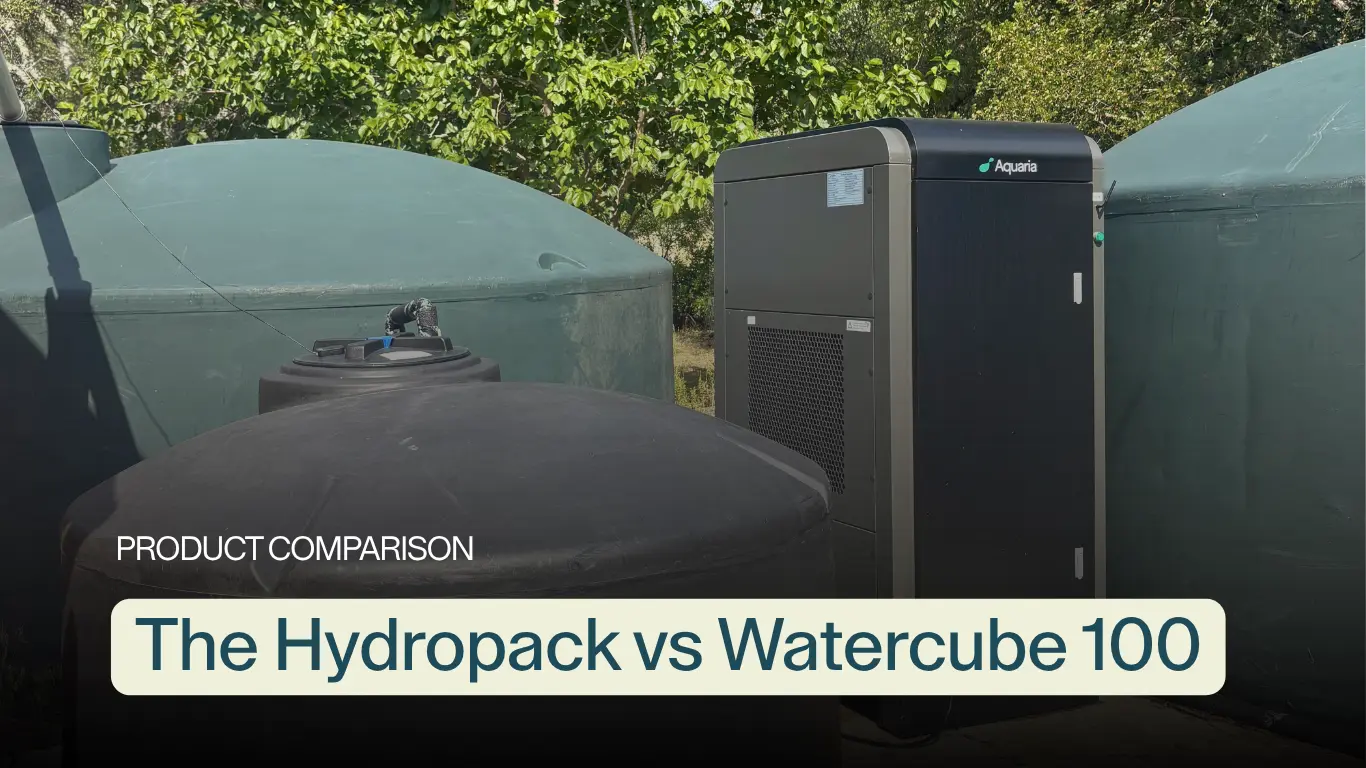
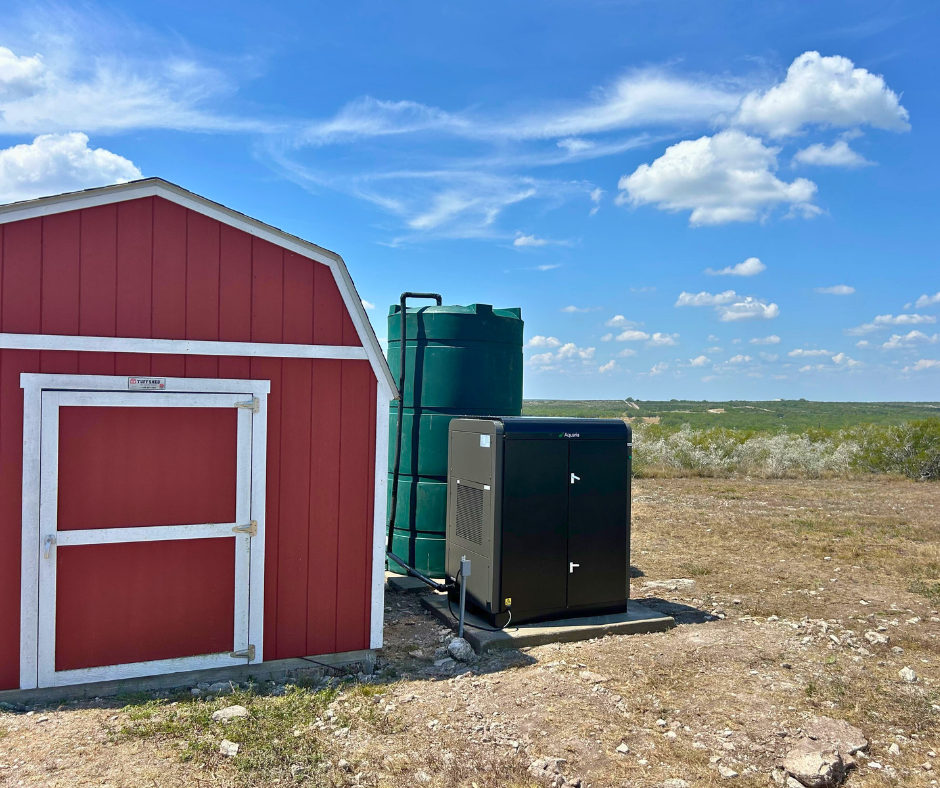
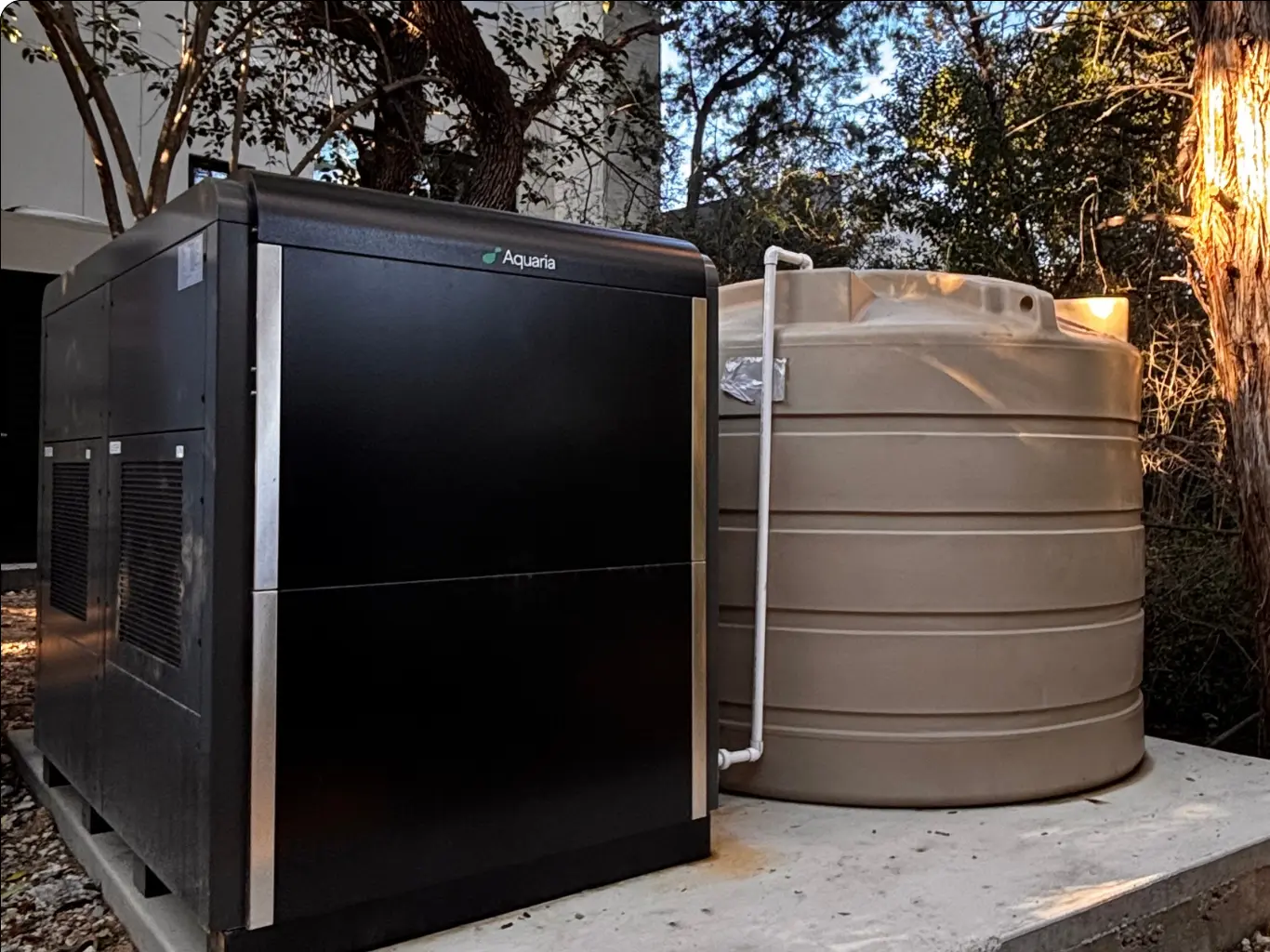
TL;DR The Aquaria Hydropack is a residential atmospheric water generator rated at 132 gallons/day in ideal conditions (around 66 gal/day at 60% relative humidity), priced at $22,499 — about $207/month with financing — and engineered to connect directly into your home's existing plumbing, so you get water at every tap. Its closest comparison in the market is the Genesis WaterCube 100; also a residential AWG, rated at 120+ gallons/day and priced at $26,999 (Care Plan and shipping not included). It's an appliance-style unit with a 36-gallon onboard reservoir that integrates with home plumbing and external storage. Where we see the two differing is in the depth of that plumbing integration.
Both sit in the same output tier and come up in the same buyer conversation. The decision usually comes down to one question: do you want a stand-alone dispenser, or water at every fixture in the house?
Quick spec comparison
A note on "120+ vs. 132": the two units publish rated outputs in the same residential capacity tier. The WaterCube 100 at 120+ gal/day, and the Hydropack at 132 gal/day at 30°C / 80% RH. Real-world output for both depends on local temperature and relative humidity. Per Aquaria's sizing estimator, the Hydropack runs closer to 66 gal/day at 60% RH. Genesis doesn't publish a derating curve for the WaterCube, so its effective output at off-rated conditions isn't externally verifiable.
Why are we comparing these two specifically?
We've spent the last few years talking with homeowners who are tired of being told a countertop dispenser is "atmospheric water generator." The Genesis WaterCube 100 and the Aquaria Hydropack are the two residential AWGs that actually compete at meaningful household capacity. Both are real machines for real households, and both are options a serious buyer should weigh.
There are a handful of other names in the category, like the Watergen GENNY at roughly 8 gal/day or the SOURCE Hydropanel at roughly 2 gal/day per panel, but those products live in a different conversation. A family of four using 120 gal/person/day total doesn't reach a useful answer with a countertop dispenser. The WaterCube 100 and the Hydropack are the two units in this output band, which is why we get the cross-shop question often enough that it earned a dedicated comparison. For a wider framework on choosing among options in the category, see our buyer's framework for atmospheric water generators.
Where are these two machines alike?
Before walking through where these machines diverge, the things they have in common are worth saying out loud:
- Same physics. Both pull water vapor out of ambient air, condense it, and run it through filtration. There is no proprietary "secret" on either side that breaks thermodynamics.
- Same general output tier. Hundreds of gallons per day is not the marketing claim; both are firmly in the "real household supply" range, not the "drinking water only" range.
- Same headline use case. Buyers in this conversation are usually trying to back up a well, replace a stressed municipal connection, or remove bottled water from their grocery list, not run a hospital. Either unit can do that job.
- Same general counterparty in the market. Both are US-manufactured. Both companies will be around in five years.
If you only need a few gallons a day for drinking and cooking, neither of these is the right scale. A smaller plug-in unit like Hydropixel would fit better for your home.
How do the Hydropack and WaterCube 100 differ?
1. Plumbing integration
This is the single biggest functional difference, and most buyers underestimate it until they're a year in.
The WaterCube 100 holds water in a 36-gallon onboard reservoir and, per their website, integrates with home plumbing and external storage. The Hydropack differs in tying directly into your existing plumbing to supply every fixture. The Hydropack ties into the home's existing pressurized plumbing. Once it's installed, the water you produce comes out of the kitchen tap, the bathroom sinks, the shower, the refrigerator line. There is no second system to manage and no separate dispenser to walk to.
2. Output under realistic conditions
The water production numbers, 120+ gal/day for the WaterCube and 132 gal/day for the Hydropack, are both stated at favorable conditions. A more useful comparison is at 60% relative humidity at room temperature, which approximates a coastal summer day or a humid inland evening:
- WaterCube 100: rated at 120+ gal/day and Genesis states 80F / 60% RH relative humidity
- Hydropack: from around 66 gal/day at 60% RH per our sizing estimator; climbs toward the 132 gal/day rated figure at warmer, more humid conditions.
At hotter, more humid peaks (the kind you get in coastal Texas or Florida in July), the Hydropack pulls ahead. The unit is engineered to keep climbing toward its 132 gal/day ceiling. At drier, cooler shoulder months, both units drop, but neither is intended to operate below 30% RH.
In steady 60% RH conditions, neither unit will hit its rated peak; both will produce less than the sticker.
3. What gets done to the water
We don't just say the Hydropack's water is clean; we've had it independently tested. Three separate labs (Microbac, Pace Analytical, and EMSL Analytical) checked it against more than 100 possible contaminants and found none of the ones people worry about most: no detectable lead, arsenic, nitrates, bacteria, PFAS, or microplastics.
Here's one easy way to picture it. "Total dissolved solids," or TDS, is simply a measure of how much stuff is dissolved in your water, the lower the number, the purer the water. The Hydropack came in at 4.54 mg/L. For comparison, the EPA allows up to 500, typical tap water runs 100–400, and bottled water 20–200. So the Hydropack's water has a tiny fraction of the dissolved content you'd find in most taps or bottles. Genesis describes the WaterCube 100's water as safe for drinking, produced through UV-C treatment, micron-level carbon filtration, and NSF-certified remineralization. As of July 28, 2026, we couldn't find published independent lab results for it, so we can't compare the two on specific numbers.
What we can say plainly is that the water source is identical: both units pull from atmospheric humidity, which never touches the ground. So neither one carries the PFAS, nitrates, or arsenic that contaminate groundwater and municipal supplies. The USGS found in 2023 that at least 45% of U.S. tap water samples contained one or more PFAS compounds — nearly half the country's tap water has a "forever chemical" in it. Both of these machines sidestep that problem entirely.
4. Software
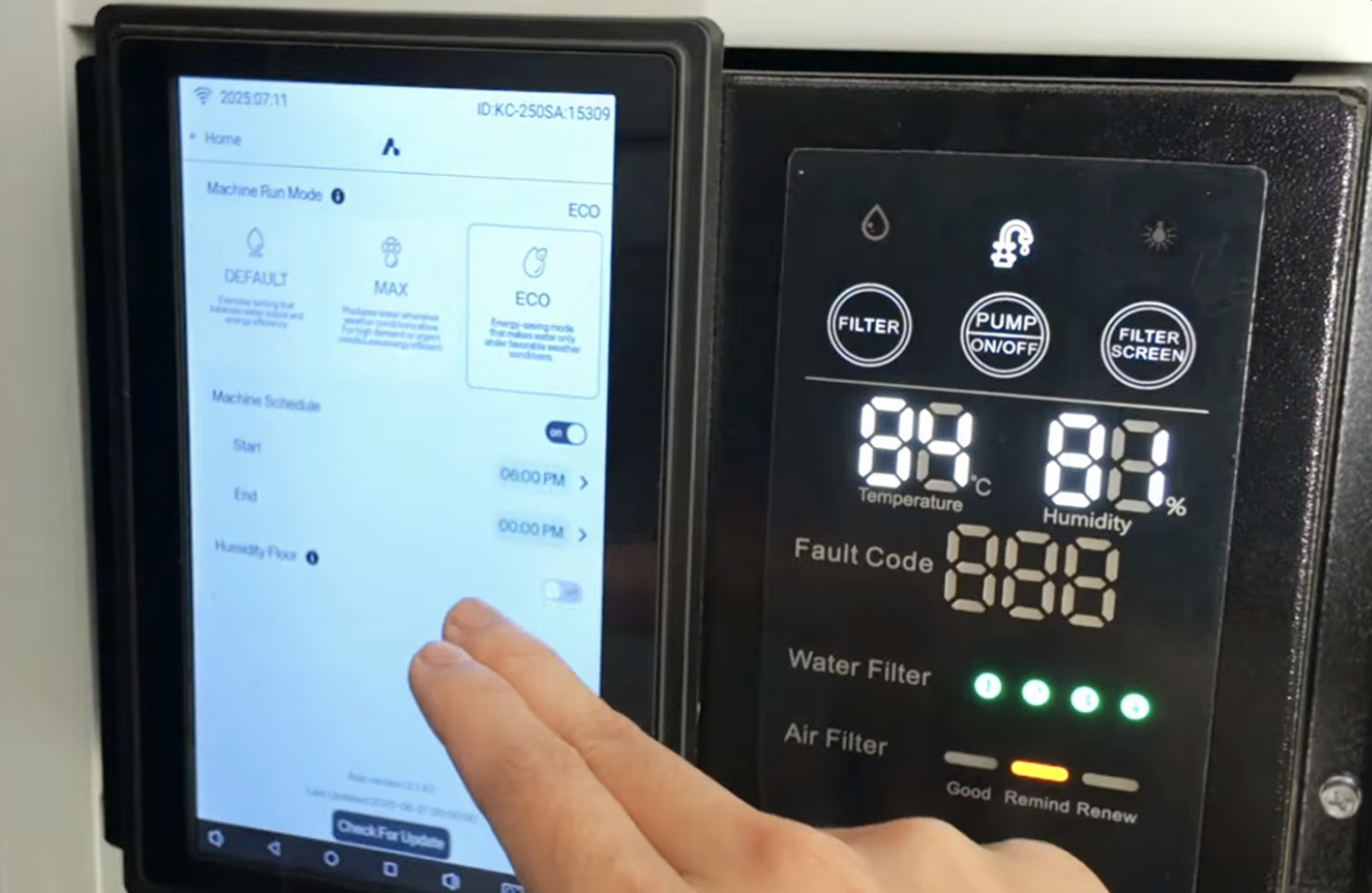
The WaterCube has a mobile app with IoT monitoring. You can see what it's doing, get alerts, check filter status.
The Aquaria app does the same monitoring work, and it also schedules production around two variables the homeowner usually can't optimize on their own: ambient humidity and solar generation. If your home has solar, the app will preferentially produce water when your panels are exporting, which cuts the marginal cost-per-gallon noticeably. If your local humidity peaks at 4 a.m., the app shifts production to that window. It's a small thing per day; it compounds.
5. Total cost
MSRP is the most-looked-at and least-useful number in this category. The cost picture has four components:
On sticker price the two are within about $4,500 — the Hydropack at $22,499, the WaterCube 100 at $26,999 — but those numbers aren't measuring the same thing.
The WaterCube 100 figure is the appliance landed at your door; shipping, its Care Plan, and any plumbing to integrate it with your whole home are separate, and we don't have a public figure for what those add up to. The Hydropack's price is the unit only too: full installation runs $10,000 to $25,000 on top, covering trenching, the storage tank, electrical, delivery, and integration into your existing plumbing. Added up, a fully installed Hydropack costs more than the WaterCube's sticker. Both are whole-home systems; the real trade-off is upfront cost against how deeply each one integrates into your existing plumbing.
For a deeper breakdown across the AWG category, see our atmospheric water generator cost breakdown.
When is the Hydropack the better choice?
- You want water at every fixture in the house, not just a dispenser in the kitchen. Whole-home integration is a genuinely different product.
- You have or are planning solar. The Aquaria app's production scheduling lines up with when your panels are generating.
- You live in a climate with wet summers. The Hydropack's higher peak output is real headroom you'll use during humid months.
- You want the option to bank water. The 74-gallon internal storage plus an external tank turns the Hydropack into a buffer, not just a producer — fill it during humid weeks and lean on it during dry stretches.
When is the Watercube 100 the better choice?
There are real situations where the WaterCube is the right unit:
- You're not retrofitting your home's plumbing. Maybe you're renting, or the home is on a slab and the install math doesn't work, or you simply don't want a contractor in the house. A stand-alone appliance is a cleaner fit.
- You want a single, contained drinking-and-cooking source alongside your existing municipal or well water, and you're comfortable filling jugs or running a short line yourself.
- Your climate sits steady around 60% RH most of the year. The WaterCube was designed and rated for those conditions, and it'll deliver close to its sticker output there.
We'd rather a homeowner buy the right product for their situation than the wrong product from us. Describe the situation above to an Aquaria advisor and they'll tell you so directly.
FAQs
How does Aquaria Hydropack output compare to WaterCube 100?
Both units publish rated capacities in the same residential tier. 120+ gal/day for the WaterCube 100 and 132 gal/day for the Hydropack at 30°C / 80% RH. Real-world output for either unit depends on local temperature and humidity. Per Aquaria's sizing estimator, the Hydropack runs closer to 66 gal/day at 60% RH. Genesis states the WaterCube 100's rated conditions but doesn't publish a full derating curve, so (as of July 28, 2026) its output at other conditions isn't externally verifiable.
Can I install either of these myself?
Neither is really a DIY job. Genesis recommends professional installation for the WaterCube 100 (it's a 240V/6kW/25A unit that integrates with home plumbing). The Hydropack, likewise: because it ties directly into your home's plumbing and electrical, it's installed by a certified technician, and we can connect you with a local installation partner to handle it.
Is the water safe to drink?
Yes. Both units produce water that meets or exceeds EPA drinking-water standards. The Hydropack has been tested independently across three labs for more than 100 contaminants, with non-detect results across PFAS, microplastics, lead, arsenic, nitrates, and bacteria. TDS measured 4.54 mg/L.
Do either of these replace a well?
The Hydropack at 132 gal/day or the WaterCube at its 120+ gal/day rated output covers typical household drinking, cooking, and significant non-potable use.