
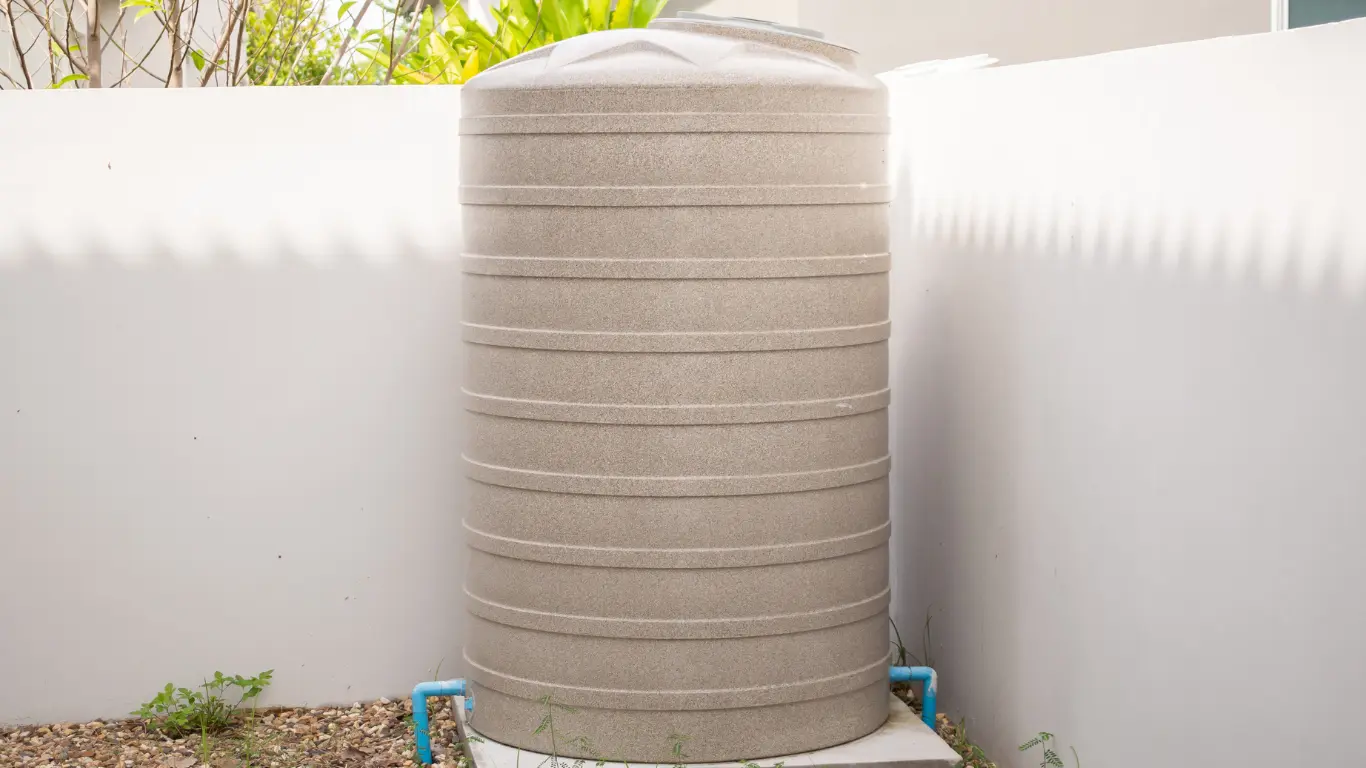
TL;DR: Size your tank to hold at least 2 to 3 days of Hydropack production. For a family of four or five using 80 to 150 gallons a day, a Hydropack paired with a 300 to 500 gallon storage tank covers most situations comfortably. Larger reserves of 1,000 gallons or more make sense if you live somewhere like Corpus Christi where municipal supply is unreliable, or if you want a true backup in case your well runs dry.
If you have been looking at the Aquaria Hydropack and trying to figure out the storage side, you have probably noticed that "what size tank do I need?" is one of those questions that sounds simple until you start pulling on it. The right answer depends on how much water your household actually uses, how many days of buffer you want, and which Hydropack model you are pairing the tank with.
We have spent the last few years helping homeowners, many of them in South Texas where Lake Corpus Christi and Choke Canyon Reservoir shriveled to 8% capacity during the latest drought, figure this out for their specific situation. The framework below is the same one we walk through when a homeowner calls and says, "family of four, two dogs, well has been acting up, what size tank?"
How much water does a typical household actually use?
The average American household uses around 300 gallons of water per day (U.S. EPA WaterSense, 2024), but that number is inflated by outdoor irrigation, pools, and big lawns. For the water that actually matters, meaning drinking, cooking, showers, dishwasher, laundry, most households use far less.
In our experience working with homeowners, a family of four typically falls between 80 and 120 gallons per day for indoor, in-home use. A family of five with two dogs lands closer to 120 to 150 gallons per day. The dogs add maybe 1 to 2 gallons each, plus a bit more dish and floor cleaning. That is the number to start with.
One household, one day, roughly the volume of two and a half full bathtubs moving through your home every 24 hours. It is a lot, but it is also a known quantity, which means you can size around it.
If you want a tighter estimate for your own household, our whole-home water solutions guide breaks down typical use by fixture and habit. For most homeowners, 80 to 150 gallons per day will be in the right ballpark.
Which Hydropack model matches your demand?
Once you know your daily use, the next question is which Hydropack you are pairing the tank with. Production rates depend on humidity and temperature, but at rated conditions (86°F / 80% relative humidity), the lineup looks like this:
Hydropack modelDaily production (rated)Good fit forHydropack S~66 gal/daySmaller households, lower-demand homes, weekend propertiesHydropack~132 gal/dayFamily of 3 to 5 using AWG as primary waterHydropack X~264 gal/dayLarger households, drier climates, higher-margin households
For a family of four or five using 80 to 150 gallons per day, the Hydropack is the comfortable match. It produces enough to cover daily use with margin, which is what you want. Production above demand is what fills the tank back up after a high-use day or a stretch of lower humidity.
In Corpus Christi specifically, the coastal humidity averages 76 to 80% year-round, so a Hydropack hits or exceeds rated production most months. That is a meaningful detail when you are sizing. You are not banking on the unit running below spec.
What is the minimum tank size you should plan for?
This is where the actual sizing decision gets made. The rule we use:
Size the tank to hold at least 2 to 3 days of Hydropack production.
That gives you a real reserve. If something interrupts production for a day, like a power blip, a maintenance check, or an unusually dry stretch, you do not notice it in the kitchen sink. From our installation guide:
For a family of four or five with a Hydropack, that puts you in the 300 to 500 gallon range as a practical sweet spot. A 330-gallon tank gives you about 2.5 days of reserve. A 500-gallon tank gives you almost 4 days, enough for a weekend trip, a holiday, or a stretch of low humidity to roll through without you thinking about it.
When is a smaller tank the right call?
A 200 to 300 gallon tank works if:
- You are on a Hydropack S with a smaller household of 2 to 3 people.
- You have reliable backup water (municipal hookup, working well) and just want AWG for drinking and cooking.
- Space is tight and you cannot site a larger tank near the unit.
In these situations, the tank is doing day-balancing, not deep-reserve storage. That is a legitimate use case. Not every household needs four days of buffer.
When does a larger tank make sense?
We see homeowners go to 1,000 gallons or more when:
- Municipal water is genuinely unreliable. Corpus Christi residents who lived through the 2026 water rationing and the drought-driven rate increases tend to want a real reserve, not a buffer.
- Their well is failing or low-yielding. If you are staring down a dry well and trying to avoid a $70,000 drilling bill, a larger tank lets the Hydropack act as your primary supply with a comfortable margin.
- They have outdoor watering, livestock, or other intermittent high-volume needs that benefit from a bigger reserve.
Brian S., a Hill Country homeowner we work with, put it bluntly: "I didn't want to put out $70,000 to drill a well when I could get into something like Aquaria." For households like his, where the well is failing and drilling is expensive or uncertain, the storage tank isn't just a buffer. It's the difference between water independence and being stuck waiting on a contractor.
For Corpus Christi specifically, where the city is now drilling emergency wells and depending on patchwork solutions, a 1,000-gallon or larger tank with a Hydropack or X gives you a stable water supply that does not depend on what the reservoirs do next month.
A few practical constraints to plan around
Tank size isn't just about gallons. Three things to check before you order:
- Distance from the Hydropack to the tank. Hydropack installations typically support up to about 45 feet horizontally and 18 feet vertically from the unit to the tank. That covers most residential layouts, but if your tank pad is far from where the unit goes, talk to your installer first.
- Site footprint. A 330-gallon poly tank is roughly 4 feet wide and 5 feet tall. A 1,000-gallon tank is closer to 6 feet wide and 6 feet tall. Most homeowners site them on a poured pad next to the house, on the side, or in a utility area.
- Local code. Some jurisdictions have setback requirements or permit thresholds for storage tanks above certain sizes. Worth a quick call to your county or city office before final sizing.
So what size do you actually need?
For a family of four or five plus two dogs, here is the short version:
- Comfortable everyday choice: Hydropack plus a 330 to 500 gallon tank. Covers daily use with margin, gives you 2.5 to 4 days of reserve.
- South Texas with reliability concerns: Hydropack plus a 1,000-gallon tank. Treats water like backup power. Meaningful reserve, not just day-to-day balancing.
- High-margin or failing well situation: Hydropack X plus a 1,000 to 2,000 gallon tank. Lets the system act as primary supply with multi-day buffer.
None of these are wrong choices. They are matched to different situations and different definitions of "enough."
Sizing is one of those decisions where a 15-minute call saves you from over- or under-buying. Site conditions, climate, daily use, and how you want the system to function as a backup all factor in.
Book a call with an Aquaria Water Expert. We will walk through your household's actual usage, your local humidity profile, your site constraints, and what you want the system to do, whether that is primary supply, backup, or somewhere in between. We will tell you honestly whether the Hydropack and a tank make sense for your situation. We will also tell you if they don't.
That is the way to get the size right the first time, instead of guessing from a table.
Frequently asked questions
Does a Hydropack work reliably in my climate?
Yes, in most U.S. residential climates. Hydropack production is rated at 86°F and 80% relative humidity, and output scales with temperature and humidity. Coastal regions (like the Texas Gulf Coast at 76 to 80% year-round humidity), the Southeast, the Pacific Northwest, and most of the Eastern Seaboard hit or exceed rated production for most of the year. Drier climates like the desert Southwest reduce output, which is why we often recommend a Hydropack X with a larger reserve tank for those homes. Our Texas weather and output guide breaks down month-by-month performance for Texas climates specifically.
How many days of water can I store?
That depends on your tank size and your daily use. A 330-gallon tank holds about 2.5 days of water for a family of four or five (120 gallons per day). A 500-gallon tank holds about 4 days. A 1,000-gallon tank holds about 8 days, which is closer to true backup territory. Most homeowners land in the 2 to 4 day reserve range for everyday use.
Can I add more storage later?
Yes. Tanks are modular. You can start with a 330-gallon tank and add a second tank later if your needs change (a growing family, a failing well, more outdoor use). Plumbing the second tank in parallel is straightforward for most installers. That said, sizing up front is usually cheaper than adding capacity later, so it is worth thinking through your 5-year situation, not just today's.
What happens if my tank runs empty?
The Hydropack keeps producing water around the clock, so an empty tank usually means production has been running below your daily use for several days in a row (extended low humidity, a maintenance pause, or higher-than-usual household demand). Most homeowners pair the Hydropack with a backup connection to municipal or well water, which kicks in automatically if the tank drops below a set level. If you do not have a backup source, sizing up the tank or the Hydropack model is the right move.
Do I need a pump between the tank and the house?
Yes, in most cases. The Hydropack pumps water into the tank. A separate external pump (and pressure tank) moves water from the storage tank to your home's fixtures at standard household pressure. Your installer will spec the right pump based on your distance, elevation, and fixture count.
Is the tank water clean enough to drink straight from?
Yes. Water leaving the Hydropack is tested and treated to U.S. drinking water standards before it enters the tank. Some homeowners add a polishing filter at the tank outlet for extra peace of mind, but the water is already clean. Aquaria publishes water quality test results for each system class.
How much does the tank itself cost?
A 330-gallon poly tank typically runs $400 to $700. A 500-gallon tank runs $600 to $1,000. A 1,000-gallon tank runs $1,000 to $1,800. Stainless or fiberglass tanks cost 2 to 4 times more but last longer. Installation (pad, plumbing, pump) adds $1,500 to $4,000 depending on site conditions. Worth pricing locally before you commit to a size.
Subscribe to our Newsletter
Get the latest updates, news and insights directly to your inbox
No payments for 6 months on any Hydropack. Get your Hydropixel delivered free in the continental US.
Get Your Free Water Plan
Two quick steps. We'll send the right system size, expected output for your climate, and exact pricing — usually within one business day.